Collagen Coffee Creamer, Explained by a Dietitian Who Reads the Studies

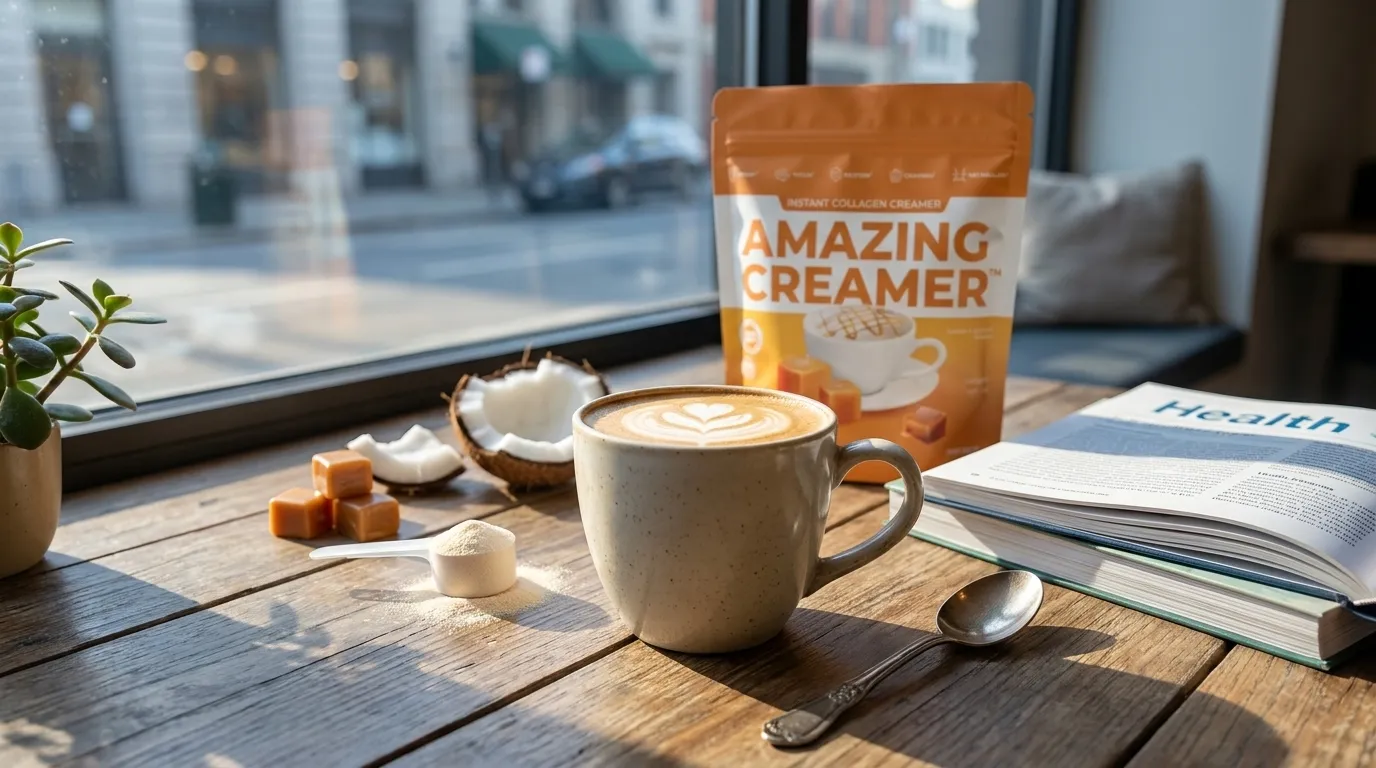
The first question someone always asks me when they hear I scoop collagen into my coffee: "Doesn't the heat just destroy it?" I get it. It's the kind of thing that sounds true. I asked it myself the first morning I stirred a pouch into a too-hot Americano and watched it dissolve without a single clump. So I went and read the thermal degradation papers, because that's the job. Short version: your coffee is nowhere near hot enough to be a problem. Longer version below — along with what the collagen, MCT oil, and hyaluronic acid in Amazing Creamer are actually doing once they're in your cup.
The "hot coffee kills collagen" myth, settled
This fear comes from a real bit of chemistry that's being misapplied. Native collagen — the long, triple-helix protein in raw skin or bone — unwinds at low temperatures, which is exactly why slow-braising tough meat turns connective tissue into silky gelatin. But that's not what's in a quality creamer.
The collagen in a supplement is hydrolyzed, meaning the structure has already been broken down into short peptides during manufacturing. Those short chains are sturdy. Hydrolyzed collagen peptides have already had their structural bonds broken during manufacturing through hydrolysis with heat, water and enzymes, the peptides are short, stable di- and tri-peptides, and they remain biologically intact through coffee, tea, hot soup and most baking temperatures, well within the heat-stable range of hydrolysed peptides.
Numbers help here. The initial degradation temperature of collagen is 572°F, while coffee is typically brewed to around 185°F. You are not getting your coffee anywhere close to that line. And it's not just dry-heat theory — a 2019 study published in the Journal of Agricultural and Food Chemistry found that collagen peptides remained stable and maintained their antioxidant activity even after heat treatment at temperatures up to 194°F (90°C) for 30 minutes. Even baking holds up: in tests replicating bakery processes, Peptan was exposed to 200°C for 20 minutes, like conditions for muffins, pancakes, or cookies, and even under these high temperatures, no breakdown was detected.
One more reassurance, because people fixate on this: once consumed, all proteins—regardless of whether they were exposed to heat or not—are further broken down by digestive enzymes in your stomach and intestines. Your gut was always going to take the peptides apart. The heat from your mug is a rounding error.

Why three ingredients instead of one
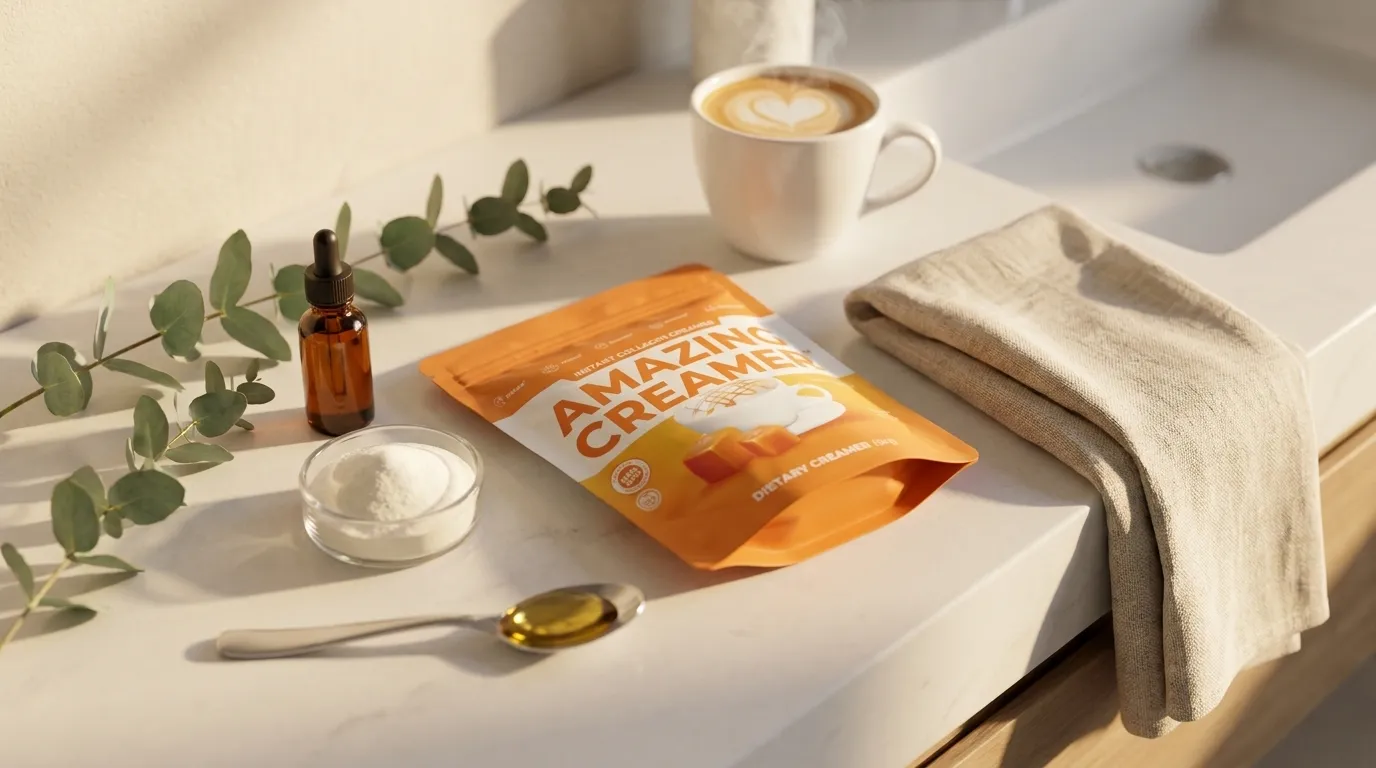
A lot of "collagen creamers" are really just collagen plus coconut milk powder. Amazing Creamer runs on three functional ingredients — MCT oil, collagen, and hyaluronic acid — and each one earns its spot for a different reason. Here's the honest breakdown of what the research supports for the ingredients themselves.
Collagen — skin, joints, hair, nails
This is the headline ingredient for good reason. The amino acids from hydrolyzed collagen — heavy on glycine, proline, and hydroxyproline — act as raw material your body can route toward connective tissue. In the dermatology literature, double-blind, placebo-controlled work (for example, "Oral supplementation of specific collagen peptides has beneficial effects on human skin physiology") points to improvements in skin elasticity and hydration. For joints, reviews like "Collagen hydrolysate for the treatment of osteoarthritis and other joint disorders" and a 24-week study in athletes with activity-related joint pain are why I take the joint claims seriously. And for hair and nails, the peptides supply building blocks for keratin — the brittle-nail and thinning-hair studies are modest but real.
I'll be straight about the ceiling, though. The broader picture is that the research is still evolving, there is no strong, consistent evidence showing that adding collagen to coffee leads to visible changes in skin or aging. It's a supplement, not a magic eraser. The people who get the most out of it are the people who actually take it daily for months.
MCT oil — energy, satiety, focus
MCTs are the reason this creamer feels different by mid-morning. They skip the slow digestion route most fats take and head straight to the liver, where they're converted to ketones. That matters for three of the benefits our customers report most:
- Steady energy. Rapidly absorbed, used as quick fuel — the studies on exercise endurance and ketogenic metabolism back the "immediate energy" framing.
- Appetite control. This is where the weight-management research is most interesting. Trials like "Medium-chain triglycerides increase energy expenditure and decrease adiposity in overweight men" tie MCTs to greater satiety and modestly higher energy expenditure versus long-chain fats.
- Mental clarity. Ketones cross the blood-brain barrier efficiently and can serve as an alternative brain fuel, which is the mechanism behind the cognition studies (e.g., "Effects of beta-hydroxybutyrate on cognition in memory-impaired adults").
This lines up with the broader consensus that studies show coffee consumption helps with fat burning and mental focus — MCTs lean into the same lane your coffee is already working.
Hyaluronic acid — the quiet one
Most creamers skip this, and it's the ingredient I'm most often asked about. Hyaluronic acid is a molecule your body already makes; it's a key component of synovial fluid that cushions joints, and it's famous for holding up to 1,000 times its weight in water. Oral HA shows up in the literature for two things in particular: skin hydration and elasticity (there are systematic reviews and meta-analyses on exactly that), and knee joint comfort ("Efficacy and safety of oral hyaluronic acid in the treatment of knee osteoarthritis"). There's even research on dry-eye relief, since HA is naturally present in the eye's vitreous humor. It pairs neatly with collagen — one supplies structure, the other helps tissues hold moisture.
What people actually tell us
Mechanisms are one thing; lived experience is another. The joint feedback is the one that stops me, because it tends to be specific and repeatable. One customer put it bluntly: "When I stop using it, my joint pain returns almost immediately." That's the kind of on-again, off-again pattern that makes me pay attention.
"I have lost 12# since I have been using your creamer, by the way I am 80 years young!!!"
The appetite notes show up constantly too — "helps with appetite," "I don't get that much hungry," "I've lost 29lbs since using this." And then there's the loyalty, which is its own kind of data: "I don't ever want to go back to regular coffee," "This creamer is seriously a life hack," and my favorite, "My only regret is not trying it sooner!" I share these as testimonials, not clinical outcomes — individual results vary, and your 80-year-old neighbor's mileage is not a guarantee. But they tell me people are reaching for it daily, which is the only way any of this works.
How I actually make it
Getting the texture right is half the battle. Here's the clump-free method I use every morning.
Everyday creamy coffee
- Brew 8–10 oz of coffee as usual. Let it sit 30–60 seconds so it's hot, not scalding.
- Add 1 scoop (one serving) of Amazing Creamer to your mug.
- Pour in just a splash of the hot coffee first — about 1 oz — and stir into a smooth paste. This pre-mixing step is what prevents clumps.
- Top with the rest of the coffee and stir, or froth for 10–15 seconds with a handheld frother.
- Optional: a pinch of cinnamon or a quarter-teaspoon of vanilla.
Iced version for warm mornings
- Mix 1 scoop into 2 oz of warm (not hot) water until fully dissolved.
- Add 6 oz of cold brew or chilled coffee and stir.
- Pour over a full glass of ice. Stir once more before drinking, since cold liquids dissolve powder more slowly.
A practical tip rooted in the research: many of the MCT and collagen studies use servings in the 10-gram range, and there's interest in timing collagen around movement. If you work out, having your cup an hour or so beforehand is a reasonable, low-effort habit — no downside if it doesn't pan out.
Bottom line
Collagen coffee creamer isn't a miracle, and I'd trust me less if I told you it was. What it is: a genuinely convenient way to fold three well-studied ingredients into a ritual you already have. The heat from your coffee won't undo the collagen. The MCTs give the cup some staying power. The hyaluronic acid is a thoughtful addition most brands leave out. Drink it consistently, keep your expectations honest, and let the daily habit do the quiet work.
These statements have not been evaluated by the Food and Drug Administration. This product is not intended to diagnose, treat, cure, or prevent any disease. The studies referenced here describe the individual ingredients — collagen, MCT oil, and hyaluronic acid — and not the finished product, and they are provided for educational purposes. Individual results vary. If you are pregnant, nursing, taking medication, or have a medical condition, talk with your healthcare provider before adding any supplement to your routine.
Priya is a registered dietitian who reviews the science behind every ingredient we use. She spends her days turning clinical research into plain English.
Ready to try it for yourself?
Shop Superfoods Company