Hyaluronic Acid, In Your Coffee? What a Dietitian Found When She Read the Trials


I found the hyaluronic acid question in my inbox at 5:52 a.m., before I'd even finished my own cup. A customer wrote: "I get why hyaluronic acid is in my face serum. But why is it in my creamer? Doesn't it just get digested?" Fair question. It's the exact one I asked when we were formulating, and the exact one I spent a weekend with a stack of trials trying to answer honestly.
So here's the dietitian version — what the research actually shows about swallowing hyaluronic acid instead of smearing it on, where the evidence is genuinely good, and where I'd tell you to keep your expectations reasonable.
First, what hyaluronic acid even is
Hyaluronic acid (HA) isn't exotic. Your body makes it. It's a big, water-loving molecule that sits in your skin, your joints, and the fluid of your eyes. Its whole job is holding onto water — a single gram can bind an enormous amount of it, which is why the "1,000 times its weight in water" line gets repeated so often. It's genuinely that thirsty.
The catch is that your natural HA drops as you age. That's part of why skin gets drier and joints feel creakier over time. The theory behind oral HA is simple: top the tank back up from the inside.
The obvious objection — "won't it just get broken down?"
This was my hang-up too, and it's the smartest thing a skeptic can ask. For years the assumption was that HA is too large to survive digestion. Newer work complicates that in an interesting way. Research on how the body processes swallowed HA has found that molecular weight and gut microbiota determine the bioavailability of orally administered hyaluronic acid — gut microbiota may act as a crucial mediator of the absorption of orally administered HA, and HA may serve as a substrate for gut microbiota and thus modulate the composition of the microbial community.
In other words: it doesn't pass straight through untouched, and it doesn't get fully absorbed intact either. Your gut bacteria break it into smaller pieces. Companion work found that the presence of Bacteroides species in the gut was crucial for hyaluronan absorption, with specific microorganisms cleaving hyaluronan into unsaturated oligosaccharides under 3 kDa that are partially absorbed through the intestinal wall. Those smaller fragments can cross into circulation, and there's a growing "gut–skin axis" idea that the fragments themselves signal your own cells to make more HA. I like this evidence precisely because it's not hand-wavy — it names a mechanism instead of asserting magic.
Where the skin data is actually strong
This is the part that surprised me most, because I went in cynical. The skin evidence for oral HA is better than I expected.
A double-blind, randomized clinical trial gives you the cleanest read, and one with 129 women across age groups found that oral administration of HA significantly promoted skin hydration after 2 to 8 weeks among both young and elderly groups, skin tone improvement was observed after 4 to 8 weeks, and an increase in epidermal thickness was noted after 12 weeks. The authors framed it plainly, saying the study provides direct evidence supporting the clinical efficacy of oral intake of HA in promoting skin health.
A separate 2025 randomized, double-blind, placebo-controlled trial is worth flagging because of how it was built. It tested a hyaluronic acid matrix ingredient containing HA, sulfated glycosaminoglycans, and collagen, proposed to enhance skin health by improving hydration and structural integrity — and it ran as a 12-week trial including 60 healthy women aged 35 to 65 with signs of natural skin aging. Notice the pairing there: HA plus collagen. That's not a coincidence in the research world, and it's not a coincidence in our formula either.

Two honest caveats before you get excited
One: these are trials on ingredients, and they take weeks. The 2-to-8-week hydration window above is real and it's also a reminder — nobody's skin transforms after a Tuesday. Two: "improves hydration and elasticity" is not "erases wrinkles." I'd rather undersell this and have you pleasantly surprised.
Joints and eyes — the less-talked-about angle
HA is a headline component of synovial fluid, the stuff that lubricates your joints and keeps cartilage cushioned. That's the rationale behind studies on oral hyaluronic acid for knee osteoarthritis, where the interest is whether supplementing supports the fluid that reduces friction during movement.
It also lives in the eye. HA is naturally present in the vitreous humor and helps maintain moisture and tear-film stability, which is why it shows up in research on dry eye relief — including work in patients with Sjögren's syndrome. I'm not promising anyone's dry eyes will resolve from a creamer. I'm telling you why HA keeps appearing in these very different tissues: they all depend on water being held in place, and holding water is the one thing this molecule is spectacularly good at.
Why it's in a creamer with collagen and MCT — not alone
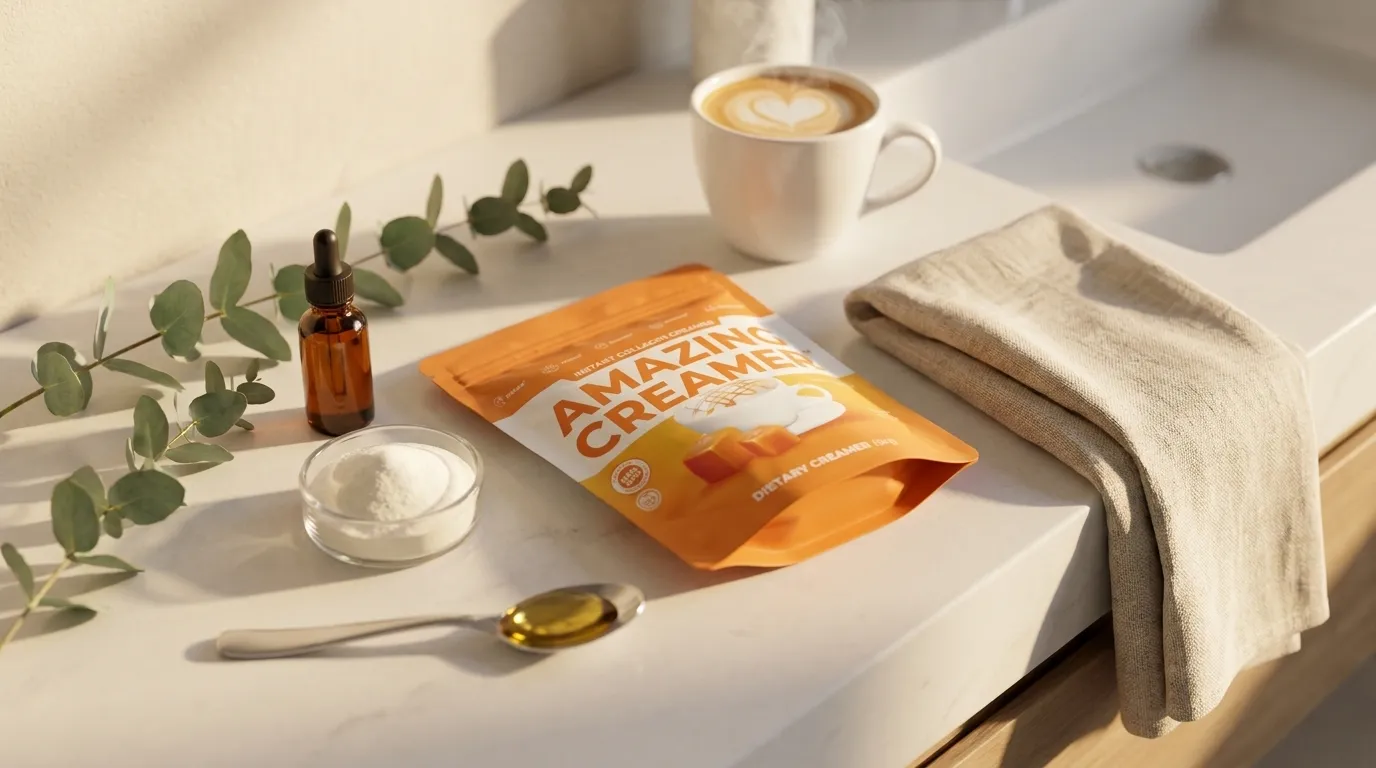
Here's the design logic, dietitian to reader. Amazing Creamer has three actives: MCT oil, collagen, and hyaluronic acid. They aren't a random pile.
- HA + collagen lean on the same skin machinery. HA supports hydration and barrier function while collagen peptides feed the amino acids your fibroblasts use to build dermal collagen. The 2025 trial above deliberately combined them for exactly this reason.
- Collagen pulls double duty on joints — collagen peptides may stimulate cartilage matrix synthesis — which stacks with HA's role in synovial fluid. Two levers on the same problem.
- MCT oil is the fat that's rapidly absorbed and converted to ketones in the liver, which is where the "clean energy" and appetite feedback come from. It's also a fat, and fat helps your morning routine actually stick, because coffee tastes good instead of like a chore.
That "sticks" part matters more than people think. The best supplement is the one you take every day without a second thought, and stirring it into coffee you already drink is about as frictionless as adherence gets.
What our own customers keep telling us
I read reviews the way I read abstracts — looking for patterns, not cherry-picking. The pattern on habit is unmistakable. One person wrote, "I don't ever want to go back to regular coffee." Another: "Never going back to regular creamers again!!! Highly recommend this creamer." The skin-and-joint notes show up constantly too, and a few are frank in a way I appreciate — "When I stop using it, my joint pain returns almost immediately," and, my favorite for the pure joy of it, "I have lost 12# since I have been using your creamer, by the way I am 80 years young!!!"
"My only regret is not trying it sooner!"
Reviews aren't clinical trials — I'd never pretend they are. But when the anecdotes and the mechanism point the same direction, I pay attention.
How I'd actually use it
- Start with one scoop in 8–12 oz of hot coffee and stir 15–20 seconds so it fully dissolves. Warm liquid helps.
- Make it your one non-negotiable morning cup — daily and consistent beats heroic and sporadic. The skin data ran on weeks, not days.
- Drink water alongside it. HA's whole trick is binding water; give it some to work with.
- Give it a real 8–12 weeks before you judge the skin and joint side, which lines up with how the trials were designed.
These statements have not been evaluated by the Food and Drug Administration. This product is not intended to diagnose, treat, cure, or prevent any disease. The research described here investigates individual ingredients — hyaluronic acid, collagen, and MCT oil — and not the finished product, and individual results will vary. If you're pregnant, nursing, managing a medical condition, or taking medication, talk to your healthcare provider before adding a new supplement.
Priya is a registered dietitian who reviews the science behind every ingredient we use. She spends her days turning clinical research into plain English.
Ready to try it for yourself?
Shop Superfoods Company