The Ten-Minute Window: What the Science Says Amazing Coffee K-Cups Are Actually Doing

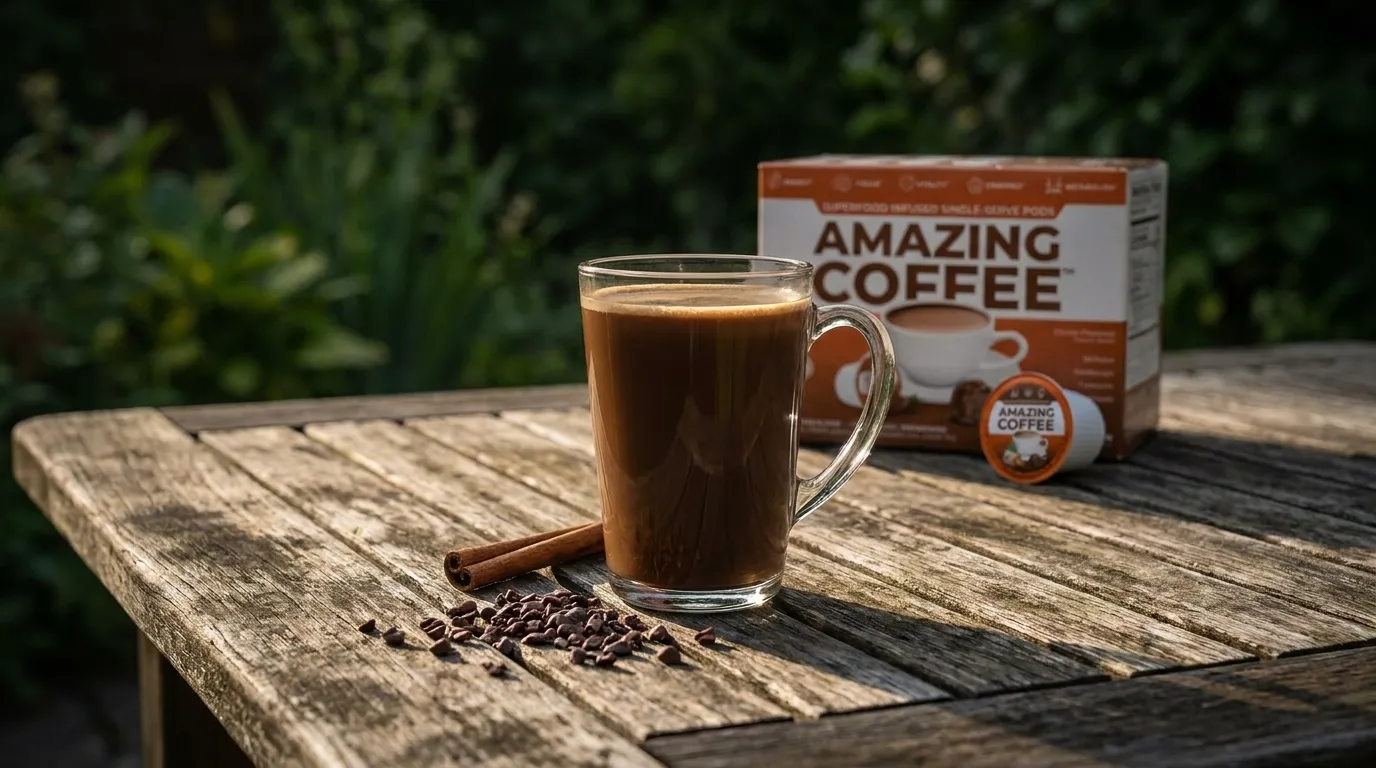
The first time I really paid attention, it was 2:47 on a Tuesday and I was standing at my kitchen window watching a squirrel lose a fight with a bird feeder. I'd had this cup maybe ten minutes earlier. And instead of the little chemical shove I usually get from an afternoon coffee — that brief lift, then the itch behind my eyes twenty minutes later — there was just... a clearing. Like someone had wiped the fog off a bathroom mirror. I didn't feel wired. I felt like I could read a paragraph and remember the beginning by the time I reached the end.
I'm a registered dietitian, so my next thought was predictably unromantic: okay, but why? I spend my days pulling apart clinical studies for this brand, and I don't take "it just works" for an answer. So here's the honest version — what the ingredients in Amazing Coffee K-Cups are doing, where the research is genuinely strong, and where it's more "promising" than "proven." No hand-waving.
Start with the obvious: it's real coffee, and caffeine has a day job
Let's not overcomplicate the base. There's French Roast and Green Coffee in every cup, which means real caffeine — and caffeine is one of the most studied compounds in nutrition science. The mechanism is elegant: caffeine blocks adenosine receptors in the brain. Adenosine is the molecule that slowly builds up while you're awake and whispers "you're tired." Caffeine sits in adenosine's chair so the message doesn't get delivered. The reviews on this (including A review of caffeine's effects on cognitive, physical and occupational performance) consistently show improved alertness, vigilance, reaction time, and attention.
That squares with what people actually tell us. One customer wrote that it "given me extra energy," and another that they "stopped needing naps during the day." Believable — that's adenosine getting benched.
So why doesn't it feel like regular coffee? The L-theanine story
Here's where it gets interesting, and where I think the "no jitters" thing stops being marketing and starts being chemistry. There's Matcha and Green Tea in the blend, and both are rich in L-theanine — an amino acid that promotes a relaxed-but-alert state. Paired with caffeine, L-theanine smooths the stimulant's sharp edge and, per meta-analyses like Effects of Tea (Camellia sinensis) or its Bioactive Compounds l-Theanine or l-Theanine plus Caffeine on Cognition, Sleep, and Mood in Healthy Participants, actually improves attention beyond caffeine alone.
This is the single best explanation I have for why customers keep using the same phrase in different words: "it doesn't give me the jitters," "does not give me that jittering feeling." You've got a stimulant and a calming compound arriving together. The result is a lift with the corners sanded off.
This is my dessert and my liquid brain during the day.
I've read that review probably fifteen times because it's the whole product in seven words.
The appetite thing — and where I get careful
This is the benefit people ask me about most, usually a little skeptically. Two customers put it plainly: "Most importantly, it suppresses my hunger" and "curbed my appetite." A third, memorably, said "my muffin top is shrinking daily."
Here's what I can and can't stand behind. Green Coffee is unroasted, which means it keeps its chlorogenic acids — polyphenols that may slow glucose absorption and nudge fat metabolism. The systematic review Chlorogenic acid in green bean coffee on body weight found support for modest body-weight reduction. I want to be honest about that word: modest. This is not a weight-loss drug.
Working in the same direction:
- Green tea catechins (EGCG): alongside caffeine, they modestly raise energy expenditure and fat oxidation — see Effect of green tea catechins with or without caffeine on anthropometric measures.
- Cinnamon: its polyphenols may improve insulin sensitivity and slow gastric emptying, which supports steadier post-meal blood sugar — the mechanism behind fewer 3 PM cravings. The updated dose-response meta-analysis on cinnamon supplementation and glycemic control is the reference here.
Steadier blood sugar is, in my clinical experience, the quiet engine behind "I stopped snacking." When your glucose doesn't spike and crash, your brain stops sending you to the pantry. That's likely a big part of what these customers are feeling.
Focus and the "brain fog lifting"
One review that stuck with me: "I did feel some brain fog lift." A vague sentence, but the blend gives it three plausible mechanisms.
- Ginseng. This adaptogen's ginsenosides are studied for reducing mental fatigue and supporting working memory (Antifatigue Effects of Panax ginseng).
- Cocoa. Cocoa flavanols improve blood-vessel function and cerebral blood flow — more blood to the brain is linked to better mood and less mental fatigue (The acute and sub-chronic effects of cocoa flavanols on mood, cognitive and cardiovascular health).
- Maca Root. Studied for improving self-reported mood and energy, plausibly through effects on stress resilience (Acceptability, Safety, and Efficacy of Oral Administration of Extracts of Black or Red Maca).
None of these is a lightning bolt. Together, though, they build a floor under your attention — which fits "extra energy for a longer period of time" far better than a single caffeine spike does.
The mushrooms and roots doing the slower work
Not every benefit shows up in ten minutes. Some are the kind you notice over weeks.
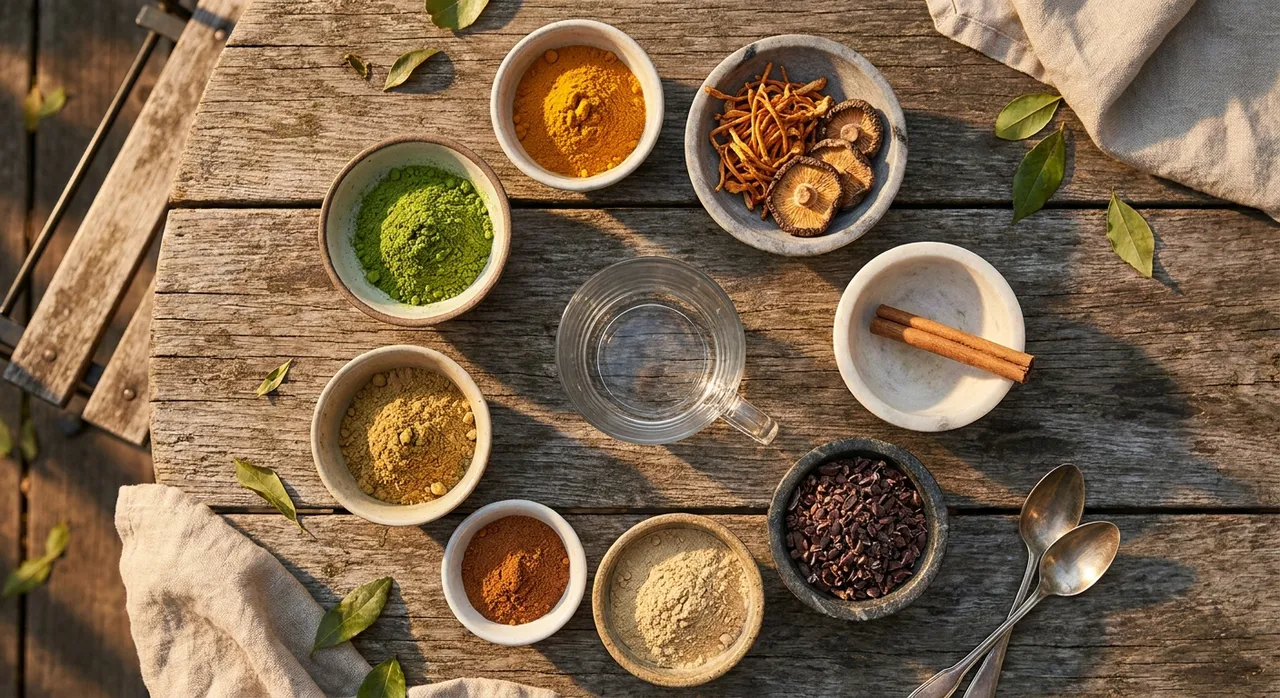
Cordyceps is studied for improving oxygen utilization (VO2max) and tolerance to high-intensity exercise, which can translate to less perceived fatigue — Cordyceps militaris Improves Tolerance to High-Intensity Exercise. Shiitake brings beta-glucans, including lentinan; a human trial (Consuming Lentinula edodes Mushrooms Daily Improves Human Immunity) improved immune markers and lowered CRP. Chaga is rich in antioxidant polyphenols and D-glucans — though I'll flag that most of its evidence is still lab and animal work, not human trials. I'd rather tell you that than let you assume otherwise.
Then there's the anti-inflammatory pair, Turmeric and Ginger. Curcumin down-regulates inflammatory signaling (NF-kB), lowering markers like CRP, IL-6, and TNF-alpha (Profiling Inflammatory Biomarkers following Curcumin Supplementation). Ginger's gingerols and shogaols add antioxidant and anti-inflammatory activity of their own. This is also, not incidentally, part of why people find it "gentle on the stomach" — ginger has a long, well-earned reputation for settling things down.
My honest take as the person who reads the studies
If you already bought it, here's how I'd get the most out of it: drink it slowly over ten to fifteen minutes rather than slamming it, ideally with or just before food if appetite control is your goal — you want the cinnamon and chlorogenic acids in play while you're actually eating. And give the mushroom-and-root benefits a couple of weeks. Those aren't first-sip effects.
If you're still deciding: the individual ingredients here are backed by real, published human research, and the combination is designed thoughtfully — a stimulant balanced by a calming amino acid, a metabolism nudge paired with blood-sugar support. It won't do the work of a diet or a workout. But "steady energy without the crash" is one of the more scientifically defensible claims in this whole category, and I don't say that about many products.
That squirrel, by the way, eventually gave up on the bird feeder. I watched the whole thing, clear-headed, and got back to my studies without a nap.
These statements have not been evaluated by the Food and Drug Administration. This product is not intended to diagnose, treat, cure, or prevent any disease. The research referenced above describes individual ingredients studied in isolation, not the finished Amazing Coffee K-Cups product, and individual results will vary. If you are pregnant, nursing, taking medication, or have a medical condition, talk with your healthcare provider before adding a functional coffee to your routine.
Priya is a registered dietitian who reviews the science behind every ingredient we use. She spends her days turning clinical research into plain English.
Ready to try it for yourself?
Shop Superfoods Company