What a Registered Dietitian Actually Expects From Amazing Coffee K-Cups


The first time a colleague slid one of these pods across the break-room counter, I did the thing dietitians do at parties: I turned it over and read the ingredient panel out loud. Chaga. Cordyceps. Green coffee. Maca. My friend rolled her eyes. But I brewed one anyway, and by the time I got to the bottom of the mug I had a notebook page of things I wanted to look up.
So I looked them up. All of them. What follows is the honest version — what the research actually says about the ingredients in Amazing Coffee K-Cups, where the evidence is strong, and where it's more "promising but early." My job is to translate clinical papers into plain English, not to sell you a miracle. There isn't one. There's just a well-built cup.
Start with the obvious: it's real coffee, so it works like coffee
The base here is French Roast plus green (unroasted) coffee, and that means caffeine is doing the heavy lifting on energy. The mechanism is not mysterious. Caffeine looks enough like adenosine — the molecule that builds up all day and makes you sleepy — to sit in adenosine's parking spot on your brain's receptors without triggering the "get tired" signal. Reviews of caffeine and cognition (see A review of caffeine's effects on cognitive, physical and occupational performance, and Effect of Caffeine on Attention and Alertness Measured in a Home-Setting) consistently link that blocking action to better alertness, faster reaction time, and steadier attention.
This is the part I trust most. When customers say the pods have "given me extra energy" and "stopped needing naps during the day," that tracks cleanly with what caffeine does.
But why "no jitters"?
This is where the formula gets interesting, and where I stopped being a skeptic. The reviews I read over and over say some version of "it doesn't give me the jitters" and gives "more energy for a longer period of time." Two ingredients help explain that.
- Matcha and green tea bring L-theanine. L-theanine is an amino acid concentrated in green tea leaves. Paired with caffeine, it nudges you toward a relaxed-but-alert state and sands down the stimulant edge. The meta-analysis Effects of Tea or its Bioactive Compounds l-Theanine or l-Theanine plus Caffeine on Cognition, Sleep, and Mood found the combination supports attention better than either alone — and a 12-month trial, Effect of matcha green tea on cognitive functions and sleep quality in older adults, looked at matcha specifically.
- Green coffee slows the delivery. More on its metabolism angle below, but a gentler curve up (and down) is a big part of why people describe long, level energy instead of a spike-and-crash.
One caveat worth saying out loud: "no jitters" is partly a dose story. If you're extremely caffeine-sensitive, a smaller cup or a later start still matters. The formula smooths the ride; it doesn't rewrite your personal tolerance.
The appetite and metabolism question (the one everyone asks)
This is the most common thing people want to know, and the most common thing I have to add nuance to. Reviewers say things like "Most importantly, it suppresses my hunger," "curbed my appetite," and — my favorite for sheer honesty — "my muffin top is shrinking daily." I love the enthusiasm. Here's what the ingredient research supports.
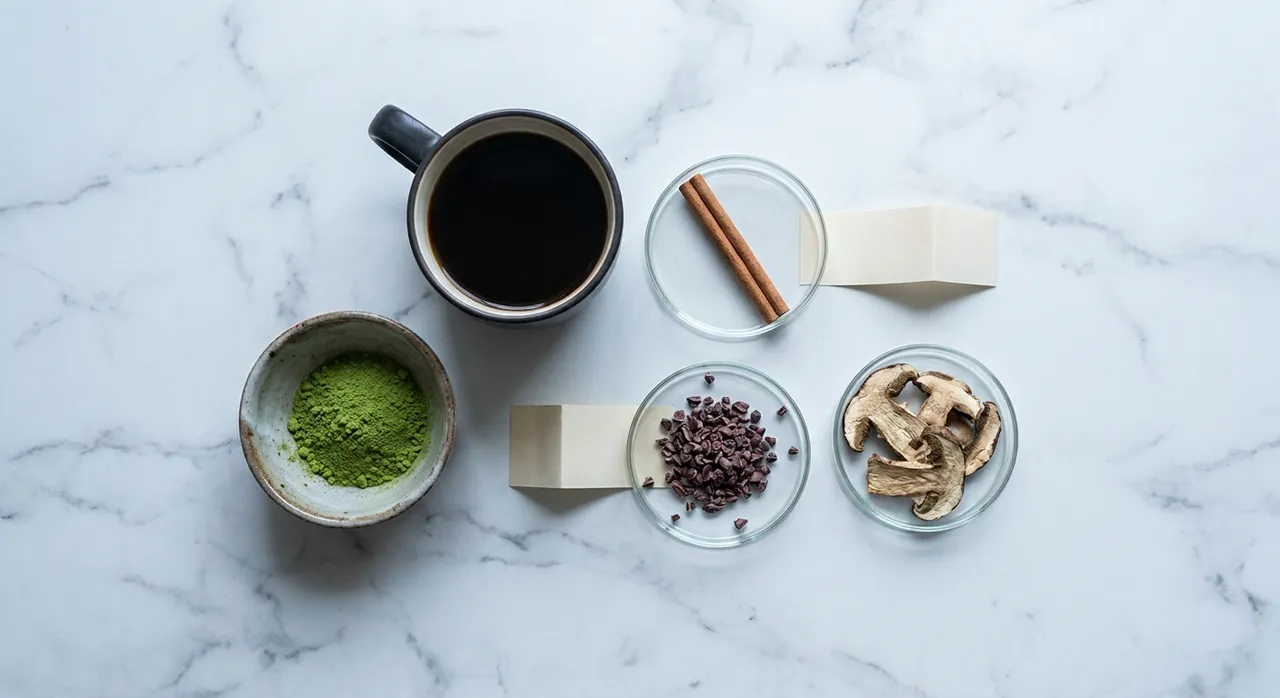
- Green coffee's chlorogenic acids. Unroasted coffee is rich in these polyphenols, which may slow glucose absorption and influence fat metabolism. The systematic review Chlorogenic acid in green bean coffee on body weight pooled randomized trials and found a modest body-weight reduction. Modest is the operative word — real, measurable, not magic.
- Green tea catechins (especially EGCG). With caffeine alongside, catechins can slightly raise energy expenditure and fat oxidation, per Effect of green tea catechins with or without caffeine on anthropometric measures and the EGCG energy-expenditure meta-analysis.
- Cinnamon for a steadier post-meal curve. Cinnamon polyphenols may improve insulin sensitivity and slow gastric emptying (The effect of cinnamon supplementation on glycemic control in patients with type 2 diabetes mellitus). Steadier blood sugar tends to mean fewer of those sharp 3 p.m. cravings.
My dietitian read: the ingredients plausibly explain a lower-key appetite and a gentle assist to metabolism. What they don't do is override a diet. The honest framing is "supportive tool," not "the reason the weight came off." People who see results are almost always changing something else too, and the cup is helping them stick to it.
Focus, mood, and the "liquid brain" effect
One review called this their "dessert and my liquid brain during the day," and another mentioned that "I did feel some brain fog lift." Beyond caffeine and L-theanine, a few ingredients round out the mental-clarity story:
- Cocoa flavanols. These improve nitric-oxide-mediated blood-vessel function and cerebral blood flow, which is linked to better mood and less mental fatigue (the young-adult cocoa flavanol RCT and the Cocoa, Cognition, and Aging (CoCoA) Study). They also happen to be why the cup tastes like a mocha.
- Panax ginseng. An adaptogen whose ginsenosides are studied for reducing mental fatigue and supporting working memory (Antifatigue Effects of Panax ginseng).
- Maca root. Studied for improved self-reported mood and energy in a placebo-controlled trial on black and red maca.
The functional mushrooms: real, but keep expectations sober
Chaga, Cordyceps, and Shiitake are the ingredients most likely to be either over-hyped or dismissed, so I want to be precise.
- Cordyceps has the most exercise-relevant human data — it's been studied for improving oxygen utilization and tolerance to high-intensity effort (Cordyceps militaris Improves Tolerance to High-Intensity Exercise), which can translate to less perceived fatigue.
- Shiitake is rich in beta-glucans, including lentinan. In a human trial (Consuming Lentinula edodes (Shiitake) Mushrooms Daily Improves Human Immunity), daily intake improved immune markers and lowered CRP.
- Chaga is polyphenol- and polysaccharide-rich with antioxidant activity — but I'll be straight with you: most of that evidence is lab and animal work so far, not big human trials.
Rounding out the anti-inflammatory corner, turmeric (curcumin down-regulates NF-kB and lowers markers like CRP and IL-6) and ginger (gingerols and shogaols with antioxidant, anti-inflammatory activity) each have human meta-analyses behind them. Small daily amounts in a beverage aren't a therapeutic dose — think steady background support, not a supplement stack in a mug.
Is it gentler on your stomach? Plausibly.
A recurring note is that it feels easier on the gut than a second cup of drip. I don't have a single trial on the finished blend, so I won't pretend to. But it lines up: ginger is a classic digestive settler, cinnamon slows gastric emptying, and the mushroom and cocoa base makes for a less acidic, more rounded cup than a straight dark roast. If regular coffee bothers you, this is a reasonable thing to try — pay attention to your own body more than to my paragraph.
So — what should you actually expect?
- Reliable, level energy from real caffeine, smoothed by L-theanine. This is the strongest claim.
- Better-behaved appetite and a small metabolic nudge from chlorogenic acids, catechins, and cinnamon — supportive, not transformative on its own.
- Sharper, calmer focus from the caffeine-plus-theanine-plus-cocoa combination.
- Background support from adaptogens and mushrooms, where the evidence ranges from solid (cordyceps, shiitake) to early (chaga).
If you already drink it and want the most out of a cup: have it earlier in the day, don't chase it with sugar, and treat the appetite effect as a helper for habits you're already building. That's how the science and the review inbox actually agree.
These statements have not been evaluated by the Food and Drug Administration. This product is not intended to diagnose, treat, cure, or prevent any disease. The research discussed here describes individual ingredients studied in isolation, often at doses that may differ from those in the finished blend, and does not constitute evidence about Amazing Coffee K-Cups themselves. Individual results vary. If you are pregnant, nursing, caffeine-sensitive, or managing a health condition, talk with your healthcare provider before adding functional coffee to your routine.
Priya is a registered dietitian who reviews the science behind every ingredient we use. She spends her days turning clinical research into plain English.
Ready to try it for yourself?
Shop Superfoods Company