Why My Brain Feels Quieter on Ashwavana Guru Focus (The Actual Science)

The first thing I noticed wasn't the focus. It was the absence of something. Around 10:30 on a Tuesday, working through a stack of ingredient dossiers, I realized I hadn't done the thing I always do at 10:30 — the low-grade fidget, the second coffee, the mental static that usually means my morning caffeine is wearing thin. My brain was just… quiet. Working, but quiet.
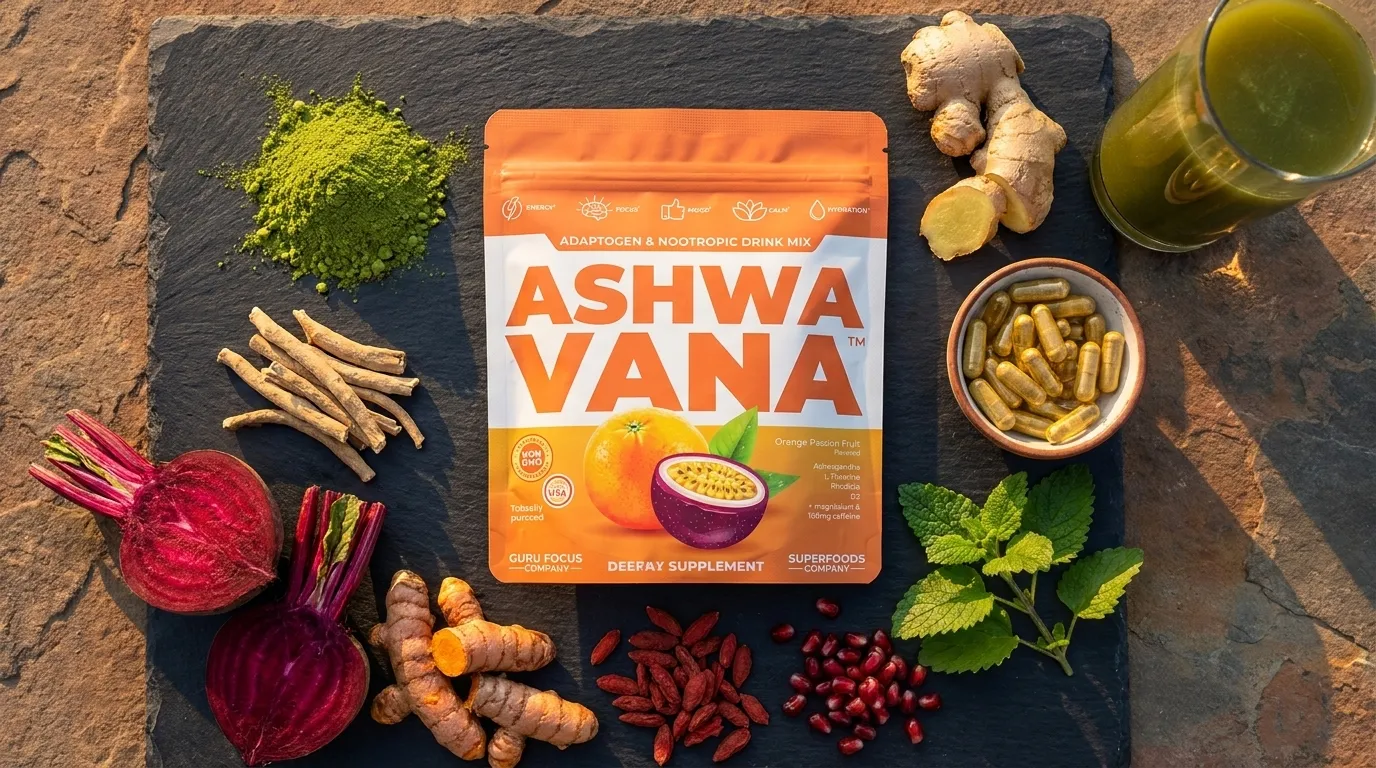
I'm a dietitian, so my instinct is to be suspicious of that feeling and go read the studies. That's literally my job here — I review the science behind every ingredient we put in Ashwavana Guru Focus. So let me walk you through what's actually happening, because "calm energy" sounds like marketing until you see the mechanisms underneath it.
The two ingredients doing the heavy lifting for focus
If you take one thing from this article, make it this pairing: L-theanine and caffeine (which comes from the matcha in our blend). This is the most-studied combination in the whole formula, and it's the reason people keep using the phrase "focused but not wired."
L-theanine is an amino acid found in tea leaves. On its own, it's a mild neural relaxant — it's been shown to increase alpha brain-wave activity, the pattern your brain produces when you're calm but alert. Not drowsy. Alert. There's a nice line I came across while researching that captures why the alpha-wave thing matters — these waves show up when you feel alert and conscious, not when you're nodding off.
Now pair it with caffeine. The reason this is interesting to researchers — and, honestly, to me — is that L-theanine seems to smooth caffeine's rough edges. Combining the two increases alpha activity and helps prevent the overstimulation caffeine can cause on its own. In the studies, that shows up as better selective and sustained attention with fewer jitters. There's a double-blind crossover trial (the "High-dose L-theanine-caffeine combination improves neurobehavioural and neurophysiological measures of selective attention in acutely sleep-deprived young adults" study) that measured exactly this — attention improving, the stimulant edge coming off.
Matcha, which we use, naturally pairs L-theanine, caffeine, and EGCG catechins in the same leaf. That's why matcha tends to feel "alert but calm" and levels out the spike-and-crash you get from energy drinks or coffee alone. The "Effects of L-Theanine Administration on Stress-Related Symptoms and Cognitive Functions in Healthy Adults" trial backs up the calm side of that equation too.
One of our reviewers put it more plainly than any study abstract: "I love the energy and focus without the jitters." Another: "leaves me feeling awake but BALANCED with a happy energy." That "balanced" is the alpha-wave state, more or less, described by someone who has never read a neurophysiology paper.
Where the "calm" actually comes from
Focus is only half the story. The other half is that your stress system isn't screaming in the background. Three ingredients target that directly.
Ashwagandha and your cortisol curve
Ashwagandha (Withania somnifera) is an adaptogen that works on the hypothalamic-pituitary-adrenal axis — the loop that governs your cortisol response. In practice, it blunts the cortisol spike that chronic stress keeps triggering. Lower morning cortisol is associated with calmer, steadier energy and less reactivity to the small stuff. Two randomized, double-blind, placebo-controlled trials are worth naming here: "An investigation into the stress-relieving and pharmacological actions of an ashwagandha extract," and the KSM-66 study in adults experiencing high stress and anxiety.
I'll be honest about the caveat, because that's more useful than hype: adaptogens like ashwagandha tend to build over days and weeks, not in the first hour. If you're evaluating whether it's working for you, give it a couple of weeks of consistent use, not one cup.
Lemon balm and rhodiola
Lemon balm (Melissa officinalis) contains rosmarinic acid, which modulates GABA pathways — the same "calm down" signaling your brain uses to take its foot off the accelerator. It's been shown to attenuate laboratory-induced stress and support a balanced mood (see the systematic review on lemon balm for depression and anxiety, and the coronary-bypass anxiety trial).
Rhodiola rosea handles a slightly different problem: mental fatigue under stress. It influences monoamine signaling and the stress response, and the classic SHR-5 study — done on physicians working night shifts, which is about as real-world-fatiguing as it gets — found meaningful improvements in mental fatigue and performance. From the broader literature, rhodiola-supported brains have measurably outperformed placebo under sleep deprivation, exam stress, and prolonged mental effort.
"It makes me feel so focused, calm, and productive all day." — the trio of effects these three ingredients are quietly building toward.
The circulation crew: why blood flow matters for a clear head
This is the part people skip, and it's the part I find most elegant. Your brain is metabolically expensive. Focus and stamina depend on getting oxygenated blood where it's needed.
- Beet root is loaded with dietary nitrate, which your body converts to nitric oxide. That widens blood vessels, nudges blood pressure down, lowers the oxygen cost of effort, and can increase regional brain perfusion (the "Dietary nitrate modulates cerebral blood flow parameters and cognitive performance" crossover study).
- Grape seed extract delivers proanthocyanidins — potent antioxidants that improve the function of the endothelium, the lining of your blood vessels, and promote vasodilation. There's a randomized trial in prehypertensive participants and a 16-trial meta-analysis on blood pressure behind that.
- Pomegranate brings ellagitannins like punicalagin. Beyond raising plasma antioxidant capacity, some trials — including an fMRI study in older adults with mild memory complaints — found it increased task-related cerebral blood flow.
None of these is a stimulant. They're plumbing and antioxidant support. But better circulation is a real, unglamorous input to feeling switched-on, and it's why I like that the formula didn't stop at the buzzy nootropics.
The metabolic steadiers (a.k.a. why there's no crash)
The word that comes up over and over in our reviews is "crash" — as in, without one. "without any sort of crash." Part of that is the L-theanine buffering the caffeine. Part of it is blood sugar.
Cinnamon polyphenols improve insulin sensitivity and slow gastric emptying, which helps flatten the glucose swings that drive both energy crashes and cravings (there's a solid meta-analysis, "Cinnamon Intake Lowers Fasting Blood Glucose"). Ginger root's gingerols support digestion and can blunt the post-meal glucose spike — the randomized "Effect of Ginger Aqueous Extract on Postprandial Glycemia" trial showed exactly that. Steadier glucose, steadier energy. It's not magic; it's just fewer peaks and valleys.
This is also, I suspect, why several reviewers mention it curbs cravings and appetite. Blunt the blood-sugar rollercoaster and the 3 p.m. cookie run gets a lot quieter.
The foundational nutrients
Two ingredients here aren't about acute focus at all — they're about not being deficient in something that quietly drags your baseline down.
Vitamin D3 acts on receptors throughout the brain and endocrine system. Correcting a low vitamin D status is linked to improved mood and reduced fatigue, and deficiency tracks with low mood and tiredness (the dose-response meta-analysis on vitamin D and depression covers this). And it's paired, smartly, with Vitamin K2 — because D3 raises calcium availability, and K2 (via matrix Gla protein and osteocalcin) helps route that calcium into bone and away from arterial walls. The two work synergistically, which is why you'll often see them together. I appreciate that detail; it means someone was thinking about the whole body, not just the buzz.
Rounding out the antioxidant support: turmeric's curcumin, which lowers pro-inflammatory cytokines like IL-6 and modulates neurotransmitter pathways (the "Curcuma longa extract improves serum inflammatory markers and mental health" trial), plus goji berry and chlorella. Curcumin's mood connection is genuinely interesting — inflammation and mood are more entangled than we used to think.
So, what do the benefits actually add up to?
Here's my honest dietitian's summary. The strongest, best-evidenced effect is the calm, jitter-free focus from the L-theanine-and-caffeine core, backed up by the stress-buffering adaptogens. The circulation and blood-sugar ingredients are the supporting cast that keep the experience smooth and crash-free. The vitamins are foundation work.
What it feels like, in the words of people who bought it and had no reason to be poetic about it: "calm, steady energy, better focus, and great hydration," and "noticeably better focus and attention span." One review I don't take lightly — "my postpartum anxiety is gone" — is a reminder that everyone's baseline is different, and results vary a lot from person to person.
If you already drink it, my one tip: be consistent for a couple of weeks so the adaptogens can do their slow work, and pay attention to that 10:30 moment. That's where I first noticed the quiet.
These statements have not been evaluated by the Food and Drug Administration. This product is not intended to diagnose, treat, cure, or prevent any disease. The research described above refers to studies on individual ingredients, not on the finished product, and individual results will vary. If you are pregnant, nursing, taking medication, or have a medical condition, talk with your healthcare provider before starting any new supplement.
Priya is a registered dietitian who reviews the science behind every ingredient we use. She spends her days turning clinical research into plain English.
Ready to try it for yourself?
Shop Superfoods Company