Awake, But Not Wired: How Ashwavana Guru Focus Actually Works


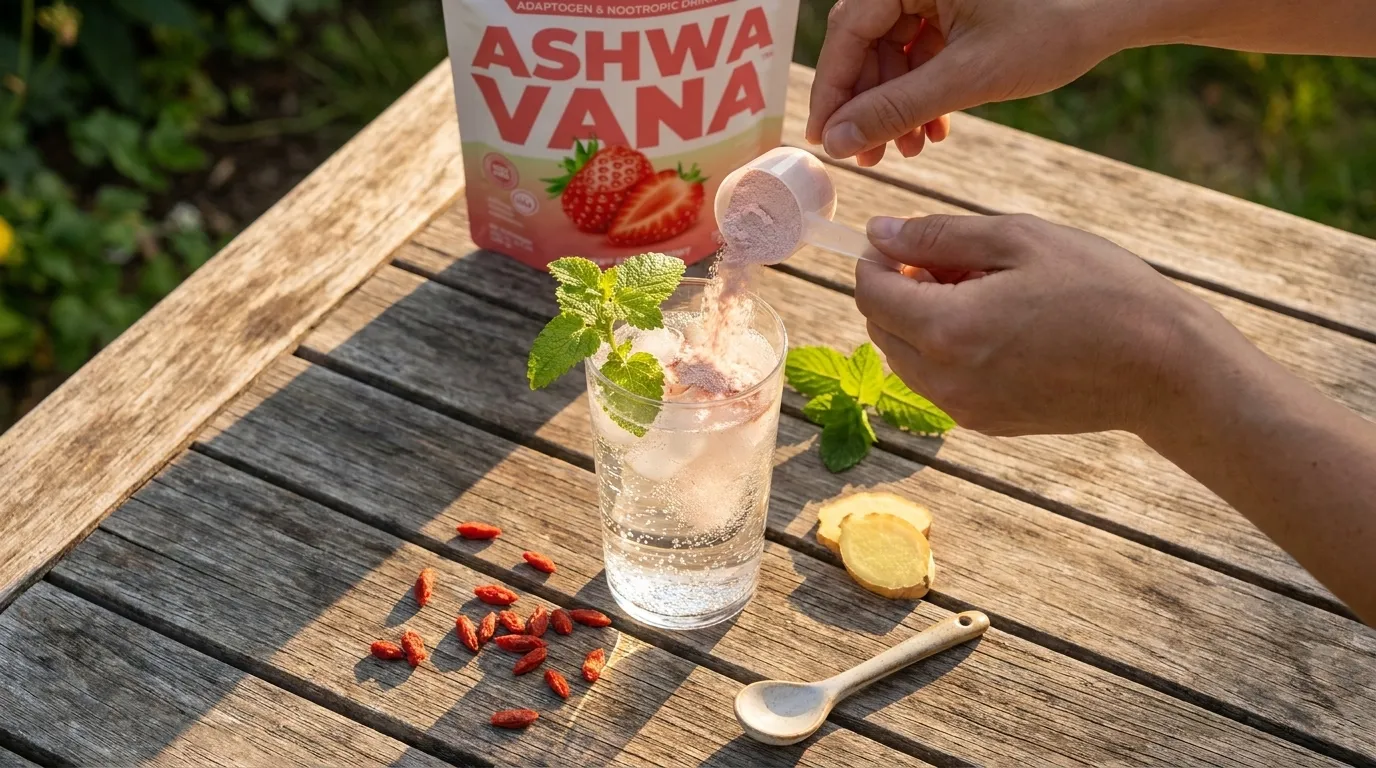
The first time it clicked for me, I was sitting at my desk at about 9:40 a.m. with a green drink instead of my usual second coffee. I noticed I'd been working for forty minutes without checking my phone — and, more tellingly, without that little hum of anxiety I usually mistake for productivity. Awake. Clear. But my shoulders weren't up around my ears. As a dietitian, I'm professionally skeptical of "feels," so I went and read the ingredient research. This is what I found.
If you already drink Ashwavana Guru Focus, this is the "why" behind what you're feeling. If you're still deciding, this is the honest mechanism — no magic, just a handful of ingredients that do specific, well-studied things.
The core idea: stimulation without the spike
Most energy products pick one lever — caffeine — and yank it hard. You get up, then you come down. The whole design philosophy here is different: pair a modest amount of natural caffeine with compounds that smooth its edges and steady your stress response. That's the difference between "wired" and what one reviewer called feeling "awake but BALANCED with a happy energy."
Here's how the pieces fit together.
L-theanine + matcha: the calm-focus engine
This is the part I find most interesting. L-theanine is an amino acid found in tea leaves. On its own it increases alpha brain-wave activity — the relaxed-but-alert state — and acts as a mild neural relaxant. Pair it with caffeine and something nice happens: the theanine takes the sharp corners off the stimulant while the two together support sustained, selective attention. In a study on acutely sleep-deprived young adults (the rather long title is High-dose L-theanine-caffeine combination improves neurobehavioural and neurophysiological measures of selective attention), the combination outperformed what you'd expect from caffeine alone.
Matcha is the natural version of that pairing. It bundles L-theanine, caffeine, and EGCG catechins together in one leaf — the combination that supports calm, focused attention and mood without the spike-and-crash of caffeine by itself. That's the "no jitters" people keep describing:
"I love the energy and focus without the jitters."
So when reviewers say "calm, steady energy, better focus, and great hydration" — this duo is doing a lot of that work.
Ashwagandha + rhodiola + lemon balm: turning the stress dial down
Energy is only half the story. The other half is not feeling frazzled while you have it.
Ashwagandha (Withania somnifera) is an adaptogen that works on the HPA axis — your central stress-response system — helping blunt the cortisol response to chronic stress. Lower morning cortisol tends to track with calmer, steadier energy and less reactivity to whatever the day throws at you. The randomized, placebo-controlled trials here (including An investigation into the stress-relieving and pharmacological actions of an ashwagandha extract and a study on KSM-66 in adults experiencing high stress) are some of the better-designed adaptogen research out there.
Rhodiola rosea covers a different angle: mental fatigue under pressure. It influences stress-response and monoamine signaling, and was studied (in the memorably specific Rhodiola rosea in stress induced fatigue trial) in physicians working night duty — exactly the kind of demanding, tiring condition where focus normally falls apart.
Lemon balm (Melissa officinalis) rounds it out. Its rosmarinic acid modulates GABA pathways, which is part of why it's been shown to attenuate lab-induced stress and support a balanced, calm mood. Together, this trio is why so many reviews read less like "energy drink" and more like relief:
- "It makes me feel so focused, calm, and productive all day."
- "helps me tackle the day without anxiety."
- "keeps my anxiety at bay."
I want to be careful here, because this matters: these ingredients are studied for stress and mood support in generally healthy adults. They are not treatments. One reviewer wrote that her "postpartum anxiety is gone," and I'm genuinely glad — but if you're dealing with anxiety that affects your daily life, please talk to your doctor, not a powder.
Beet root + grape seed + pomegranate: feeding the brain
A focused brain is a well-perfused brain, and three ingredients here support blood flow in different ways.
- Beet root is rich in dietary nitrate, which your body converts to nitric oxide — widening blood vessels and, per the Dietary nitrate modulates cerebral blood flow parameters and cognitive performance study, increasing regional brain perfusion.
- Grape seed extract delivers proanthocyanidins, potent antioxidants shown to improve endothelial (blood-vessel lining) function and support healthy blood pressure.
- Pomegranate brings ellagitannins like punicalagin; in trials with middle-aged and older adults, pomegranate juice was associated with task-related increases in cerebral blood flow and memory activity.
None of these is dramatic on its own. Stacked, they're the unglamorous plumbing that makes "steady focus" possible.
Cinnamon, ginger, turmeric: the anti-crash insurance
Here's a thing people underestimate about the 3 p.m. slump — a lot of it is blood sugar. Cinnamon polyphenols improve insulin sensitivity and slow gastric emptying, helping flatten the glucose swings that drive both crashes and cravings. Ginger's gingerols support digestion and can reduce post-meal glucose spikes. And turmeric's curcumin lowers inflammatory markers like IL-6 and oxidative stress, which the Curcuma longa extract improves serum inflammatory markers and mental health trial linked to better mood.
This is the quiet reason behind the most common phrase in our reviews — the one about no comedown:
"the energy and focus without the jitters... without any sort of crash."
D3 + K2, and the green stuff
Two more deliberate choices. Vitamin D3 acts on receptors throughout the brain and endocrine system; correcting low vitamin D status is linked to improved mood and less fatigue, and deficiency tracks with low mood and tiredness. It's paired with Vitamin K2, which activates matrix Gla protein and osteocalcin to help route calcium into bone and away from arterial walls — the two vitamins work synergistically, since D3 raises calcium availability and K2 helps direct it. Smart pairing, not filler.
Then there's chlorella, goji berry, and matcha doing antioxidant and micronutrient duty in the background. Not headliners — supporting cast.
So what does it actually feel like?
If I had to translate the mechanism into a sensation: you get up, but you don't get launched. The caffeine and matcha bring alertness; the theanine, ashwagandha, rhodiola, and lemon balm keep it calm; the blood-flow ingredients keep it sustained; and the blood-sugar ingredients keep it from ending in a crash. That's the whole architecture. Reviewers describe "noticeably better focus and attention span" and "a cleaner replacement for coffee," and now you know why that's not a coincidence.
My honest take as a dietitian: this won't fix a bad night's sleep or replace lunch. It's a well-built daily ritual, not a rescue. But as a swap for that anxious second cup of coffee? The science behind these ingredients is real, and the design is thoughtful.
These statements have not been evaluated by the Food and Drug Administration. This product is not intended to diagnose, treat, cure, or prevent any disease. The research described above examines individual ingredients, not the finished product, and individual results vary. If you are pregnant, nursing, taking medication, or have a medical condition, consult your healthcare provider before use.
Priya is a registered dietitian who reviews the science behind every ingredient we use. She spends her days turning clinical research into plain English.
Ready to try it for yourself?
Shop Superfoods Company