
The 10 A.M. Coffee Crash, Explained (and How to Skip It)

The first time I noticed it, I was standing in a client's kitchen at 7:15 a.m. She'd made herself a huge mug of drip coffee, drank it fast, and within twenty minutes her hands had a faint tremor while she scrolled her phone. By 10:30 she texted me that she was "dead again" and reaching for a second pot. I hear some version of this constantly — and it's not a willpower problem. It's chemistry.
So let's actually get into how coffee wakes you up, why it can turn on you, and what a blend like Amazing Coffee is doing differently. I promise to keep the pharmacology in plain English.
First: how coffee wakes you up at all
All day, a molecule called adenosine builds up in your brain. Think of it as a pressure gauge for tiredness — the higher it climbs, the sleepier you feel. Within 15 to 45 minutes of drinking a cup of coffee, caffeine travels through the bloodstream and reaches the brain, where it blocks adenosine receptors, the neural "brakes" that help promote calm and drowsiness.
Caffeine doesn't add energy. It just parks itself in the adenosine parking spots so your brain can't read the "I'm tired" signal. This is why caffeine can make us feel more alert no matter the time of day — but once our bodies metabolise and remove caffeine, built-up adenosine can then bind to the receptors.
That last part is the whole crash, in one sentence. The tiredness didn't go away. It waited.
So where do the jitters come from?
Two things, mostly. The first is dose. The jittery feeling is characterised by nervousness, shakiness, increased heart rate, restlessness, and sometimes anxiety — sensations that typically result from consuming too much caffeine. If you're on cup three of strong drip before breakfast, you've stacked a lot of stimulant into an empty stomach fast.
The second is the stress-hormone side of caffeine. It's not just blocking your sleep signal — it's also revving your fight-or-flight system. The caffeine in coffee increases catecholamines, a neurotransmitter that signals the release of the stress hormone cortisol, as well as insulin. That cortisol spike is part of why a big cup can feel less like "awake" and more like "vaguely panicked at my desk."
And there's a genetic wrinkle worth naming, because it explains why your friend can drink espresso at 9 p.m. and you can't. People with certain gene variants process caffeine more slowly, allowing it to linger in the bloodstream and prolonging its stimulating effects, which can contribute to feeling more anxiety. If that's you, you already know. You've felt it.

The trick isn't less energy — it's smoother energy
Here's the part that changed how I think about my own morning cup. You don't actually want to blunt caffeine. You want to smooth its edges so the lift is even instead of spiky. And there's a well-known pairing that does exactly that: caffeine with an amino acid called L-theanine, which shows up naturally in green tea and matcha.
Green tea's caffeine and L-theanine combo may boost focus and promote calm, sustained alertness, and its lower caffeine content makes it a gentler alternative to coffee for morning energy. The theanine is the quiet co-pilot here. L-theanine moderates the stimulatory effects of caffeine, leading to a smoother, prolonged energy release — one of the reasons green tea provides a balanced energy boost unlike other caffeinated beverages.
People who study this pairing describe it the same way, over and over. Pairing L-theanine with caffeine delivers focused energy without the usual downsides — the combination sharpens mental performance while keeping you calm and steady, with benefits showing up strongest in your ability to concentrate. That's the phrase you'll see everywhere: the classic duo of caffeine and L-theanine offers stimulant-driven wakefulness from caffeine paired with the calming, alpha-wave–promoting effects of L-theanine.
How Amazing Coffee is built around that idea
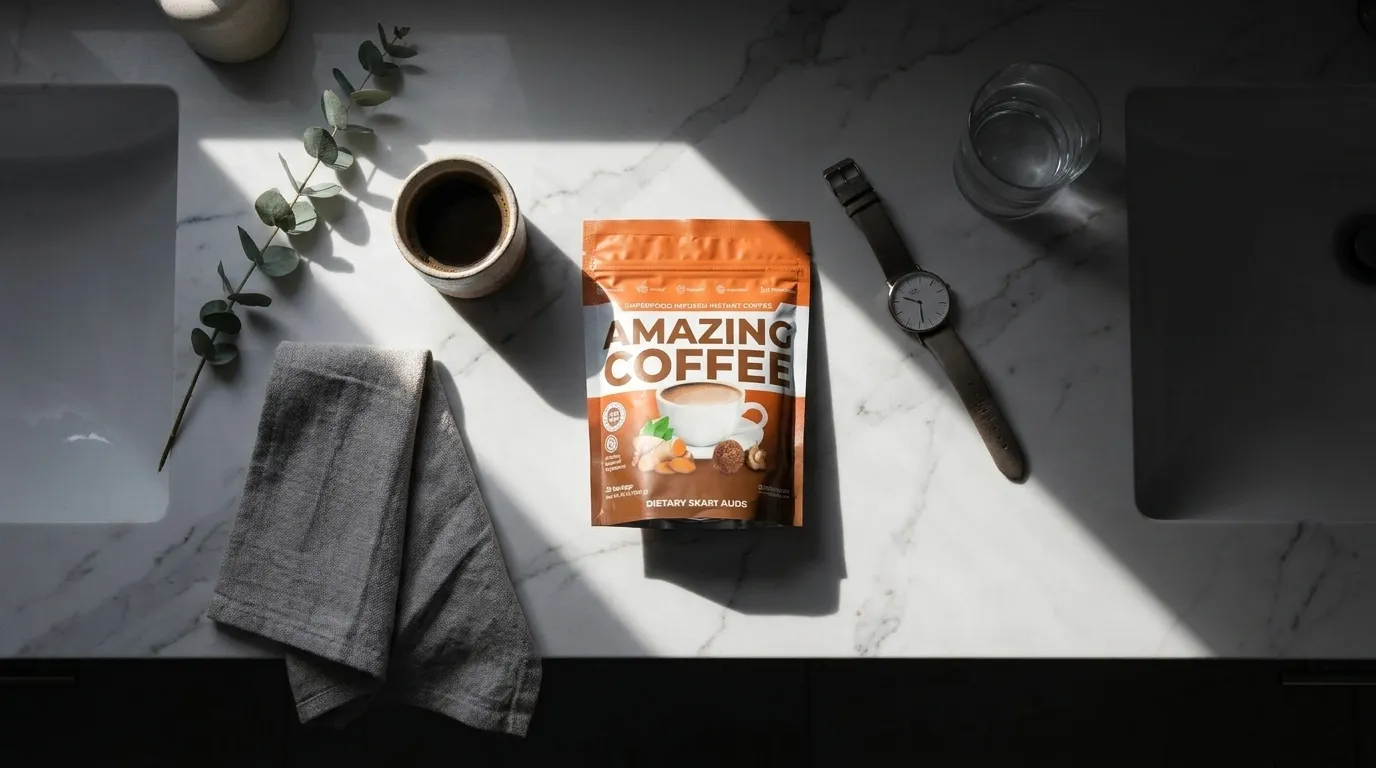
This is the "how it works" part I actually care about. Amazing Coffee isn't just coffee with a health halo — it's a blend where the coffee is deliberately kept company by ingredients that either soften the spike or add a different, non-jittery kind of energy. The relevant crew:
- Matcha and Green Tea — the L-theanine source. This is the calm-focus lever from the research above, built right into the cup rather than something you have to remember to add.
- Green Coffee — unroasted coffee that carries chlorogenic acids alongside its caffeine, so the caffeine isn't arriving completely naked.
- Cordyceps — a mushroom studied for a totally different energy pathway. Cordyceps contains bioactive compounds like cordycepin and polysaccharides that may improve cellular energy production by enhancing ATP synthesis and oxygen utilization. That's energy at the mitochondrial level, not a nervous-system jolt.
- Chaga and Shiitake — the antioxidant and immune-support backbone. Chaga is rich in antioxidant compounds including melanin, phenolic compounds, and superoxide dismutase that help neutralize free radicals and reduce oxidative stress.
- Turmeric, Ginger, Cinnamon, Cocoa, Maca, Ginseng — flavor and function. Turmeric earns its keep here: curcumin, the primary active compound in turmeric, inhibits inflammatory pathways including NF-κB, cyclooxygenase-2, and lipoxygenase.
The point isn't that any single mushroom is magic. It's the composition. You get real caffeine — enough to wake up — sitting next to theanine that keeps it from turning into a stress response, plus a slower, cellular energy source underneath. That's the mechanism behind the review I read most often:
"Never a crash feeling like coffee."And my personal favorite, because it names the technique:
"It really does curb your appetite. You need to allow it to work, after you drink your cup just relax and feel the fullness!!"
How to actually drink it for steady energy
The blend does a lot, but how you use it matters. This is the routine I give clients who want the lift without the shakes:
- Eat something first. Even a few bites. Caffeine on a truly empty stomach hits harder and faster — that's a big part of the jitter equation.
- Use 1 heaping teaspoon in 8–10 oz of hot (not boiling) water. Around 200°F. Boiling water scorches the more delicate green tea and matcha notes.
- Stir 20–30 seconds so it fully dissolves — instant blends clump if you rush.
- Then wait ten minutes before you decide you need more. This is the single most common mistake. The lift here is gentler on purpose; give it time before you double up.
- Cap it by early afternoon if you're caffeine-sensitive, so it doesn't touch your sleep.
A quick honest caveat: "no jitters" is not the same as "no caffeine." There's real caffeine in here, so if you're pregnant, on certain medications, or extremely stimulant-sensitive, talk to your doctor and start with a smaller scoop. Smooth energy is still energy.
Do I think it's a miracle? No. I think it's a smarter delivery system for something most of us are going to drink anyway. One reviewer wrote,
"My only regret is that I did not do this sooner"— and while I can't promise you that, I can tell you the chemistry behind why the morning feels different is real, and it's the theanine-and-caffeine story doing most of the quiet work.
These statements have not been evaluated by the Food and Drug Administration. This product is not intended to diagnose, treat, cure, or prevent any disease. The research cited here describes individual ingredients studied on their own, not the finished Amazing Coffee product, and individual results vary. Nothing here is medical advice — please consult your healthcare provider before making changes to your diet, especially if you are pregnant, nursing, or managing a health condition.
Priya is a registered dietitian who reviews the science behind every ingredient we use. She spends her days turning clinical research into plain English.
Ready to try it for yourself?
Shop Superfoods Company