Collagen Creamer for Skin: What Happens When You Stir It Into Hot Coffee

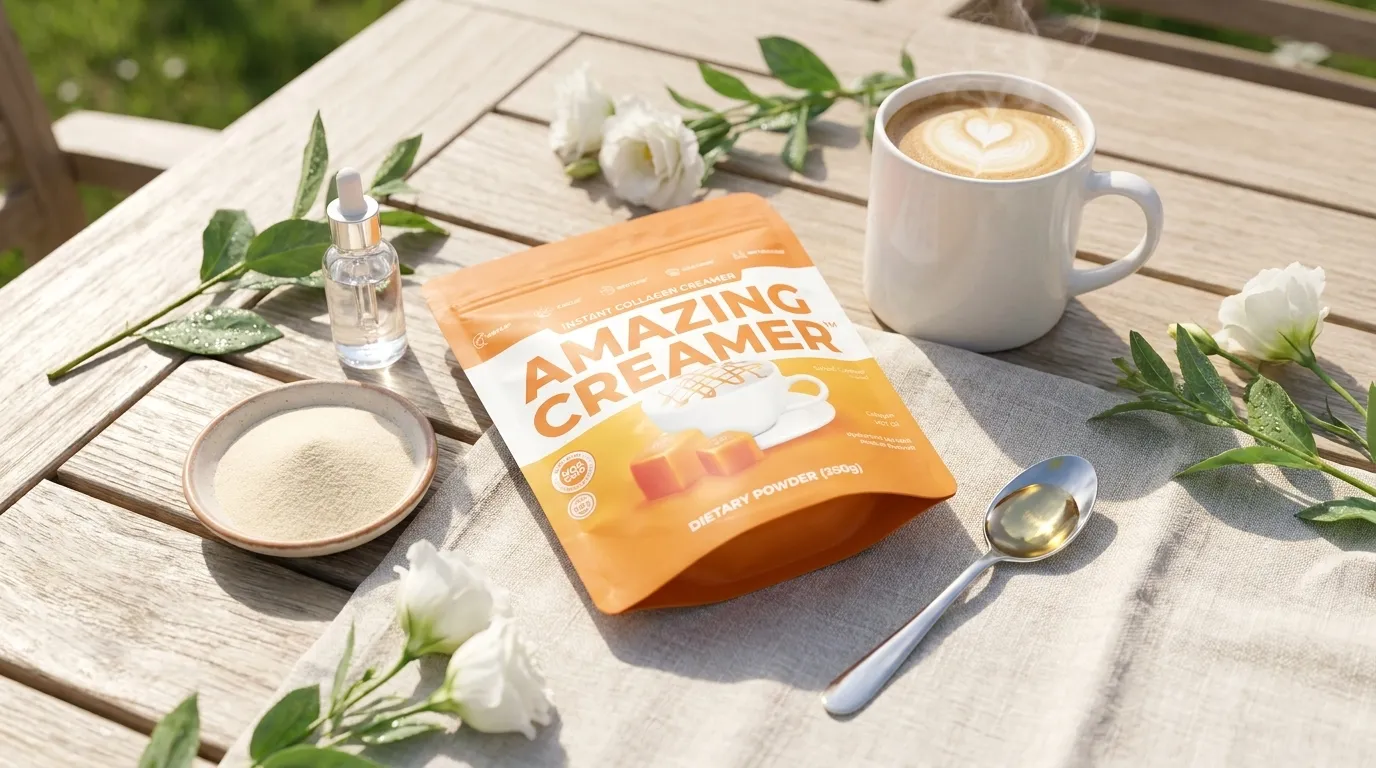
The first time I paid attention to my skin instead of my energy, it was a Tuesday in February and my face looked like it had been through a wind tunnel. Dry cheeks, tight forehead, the works. I'd been stirring a scoop of collagen creamer into my coffee for weeks — mostly for the flavor and the steady morning energy — and it hadn't occurred to me that the same cup might be doing something quieter, further down. So I did what I always do when a customer asks me "but does it actually reach my skin?": I went and read the studies. Here's the honest version.
First, the question everyone asks: does the hot coffee ruin it?
This is the objection I hear most, and it's a fair one. You're pouring collagen into liquid that's steaming. Doesn't heat destroy it?
Short answer: no — not at the temperatures your coffee actually is. The collagen in a creamer is hydrolyzed, meaning it's already been broken down into short peptides before it ever hits your cup. The peptides are short, stable di- and tri-peptides, and they remain biologically intact through coffee, tea, hot soup and most baking temperatures. And your coffee isn't as hot as you think once it's drinkable — coffee at typical drinking temperature is around 60 to 80 degrees, well within the heat-stable range.
There's lab work backing this up beyond the "it feels fine" level. A 2019 study published in the Journal of Agricultural and Food Chemistry found that collagen peptides remained stable and maintained their antioxidant activity even after heat treatment at temperatures up to 194°F (90°C) for 30 minutes. Your coffee is neither that hot nor sitting in the mug for half an hour.
The reassuring part, for anyone who cares whether this is a real routine or a placebo latte: the skin research itself was often done in hot liquid. A 2016 clinical study, which evaluated daily consumption of collagen peptides dissolved in a hot beverage for 8 weeks, demonstrated significant improvements in skin moisture, skin elasticity and skin texture for participants who consumed the collagen dissolved in hot liquid compared with the participants in the placebo group. So the coffee isn't a compromise. It's basically the delivery method they tested.

How collagen gets from your mug to your skin
Here's where I have to be a dietitian and not a marketer. When you drink collagen, it does not travel up to your face like a delivery truck and unload at your cheeks. That's not how digestion works.
What actually happens: your body doesn't absorb whole collagen molecules directly — the amino acids that comprise collagen peptides remain intact and absorbable, and your digestive system processes these amino acids the same way whether they arrived via hot or cold liquid. Those amino acids — glycine, proline, and the collagen-specific hydroxyproline — get absorbed into your bloodstream.
The interesting mechanism, and the reason collagen peptides are more than "just protein," is a signaling one. According to the research summarized in Oral supplementation of specific collagen peptides has beneficial effects on human skin physiology: a double-blind, placebo-controlled study and the review Oral collagen supplementation: A systematic review of dermatological applications, the peptide fragments appear to do two jobs: they supply raw material for dermal collagen synthesis, and they seem to nudge your fibroblasts — the cells in your skin that build collagen — to get to work. In other words, part food, part message.
Two of our three functional ingredients are pulling in the same direction here:
- Collagen — the building blocks and the signal, as described in Oral supplementation of specific collagen peptides has beneficial effects on human skin physiology.
- Hyaluronic acid — the water-holder. Research described in Promotes Skin Hydration and Elasticity work such as Oral hyaluronic acid supplementation improves skin hydration and elasticity: A systematic review and meta-analysis notes that hyaluronic acid can hold up to 1,000 times its weight in water and supports skin barrier function and collagen synthesis. That's why we didn't leave it out of Amazing Creamer.
The third ingredient, MCT oil, isn't a skin ingredient per se — it's the reason the creamer carries you through the morning without the mid-morning crash. But it does one useful thing for skin specifically: it makes the drink genuinely satisfying, which is a big reason people keep drinking it every single day. And with skin, daily is the whole game.
The timeline nobody wants to hear (but should)
Skin is slow. Your body renews the outermost layer of skin roughly every month, and the deeper dermal changes that collagen studies measure take longer still. Most of the well-run trials ran for 8 to 12 weeks before they saw statistically meaningful shifts in hydration and elasticity.
So if you've been at it for nine days and you're squinting in the mirror looking for a miracle — stop. Give it two to three months of consistent daily use, ideally with a photo at the start so you're not relying on memory. Memory is a terrible dermatologist.
What I tell people to actually watch for, in order:
- Weeks 1–2: nothing visible on skin yet. This is normal. You may notice the energy and appetite side first.
- Weeks 3–6: hydration is usually the earliest skin change people report — skin that feels less "tight," a little more supple.
- Weeks 8–12: the elasticity and texture changes the studies measured tend to show up in this window, if they show up for you.
"My only regret is not trying it sooner!" — that's one of our reviews, and honestly it's the timeline talking. The people who love the skin results are the ones who stuck it out past the boring part.
How to use it so it actually counts
The best supplement is the one you don't forget. A creamer works for skin precisely because it's welded to a habit you already have — the first coffee. You're not adding a step; you're upgrading one. As more than one customer put it, "I don't ever want to go back to regular coffee," and another, "Never going back to regular creamers again!!! Highly recommend this creamer." That stickiness is the point.
My simple daily method:
- Brew your coffee as usual, then let it sit 60–90 seconds so it drops to drinking temperature (nice bonus: you won't scald your tongue).
- Add 1 scoop of Amazing Creamer.
- Stir well for about 15 seconds, or froth it — the MCT emulsifies better with a little agitation and you'll avoid any powdery cling at the bottom.
- Drink it. Same time, every day. Consistency beats intensity here.
If you're an iced-coffee person in summer, don't worry — cold works exactly as well for absorption. Blend it or shake it in a jar with a few ice cubes so the oil doesn't separate.
A few honest caveats
- Collagen is not a sunscreen. If you're serious about skin, wearing SPF does more against visible aging than any drink. The creamer is a "both, not instead" thing.
- Results are individual. The studies show average improvements across groups, not a guarantee for every person.
- Hydration, sleep, and not smoking still matter more than any single ingredient. Boring, true, worth saying.
I got into this work because I like turning dense clinical papers into something you can act on before 8 a.m. And the short, honest version of the skin question is this: yes, a collagen creamer can reach your skin, the hot coffee doesn't wreck it, the mechanism is real but gradual, and the reason it works is that you'll actually drink it every day. If you've been curious, the two-to-three-month experiment is a low-stakes one to run on yourself. Take the "before" photo first.
These statements have not been evaluated by the Food and Drug Administration. This product is not intended to diagnose, treat, cure, or prevent any disease. The research referenced above describes individual ingredients such as collagen peptides, hyaluronic acid, and MCT oil, not the finished Amazing Creamer product, and individual results will vary. Consult your healthcare provider before starting any new supplement, especially if you are pregnant, nursing, or managing a medical condition.
Priya is a registered dietitian who reviews the science behind every ingredient we use. She spends her days turning clinical research into plain English.
Ready to try it for yourself?
Shop Superfoods Company