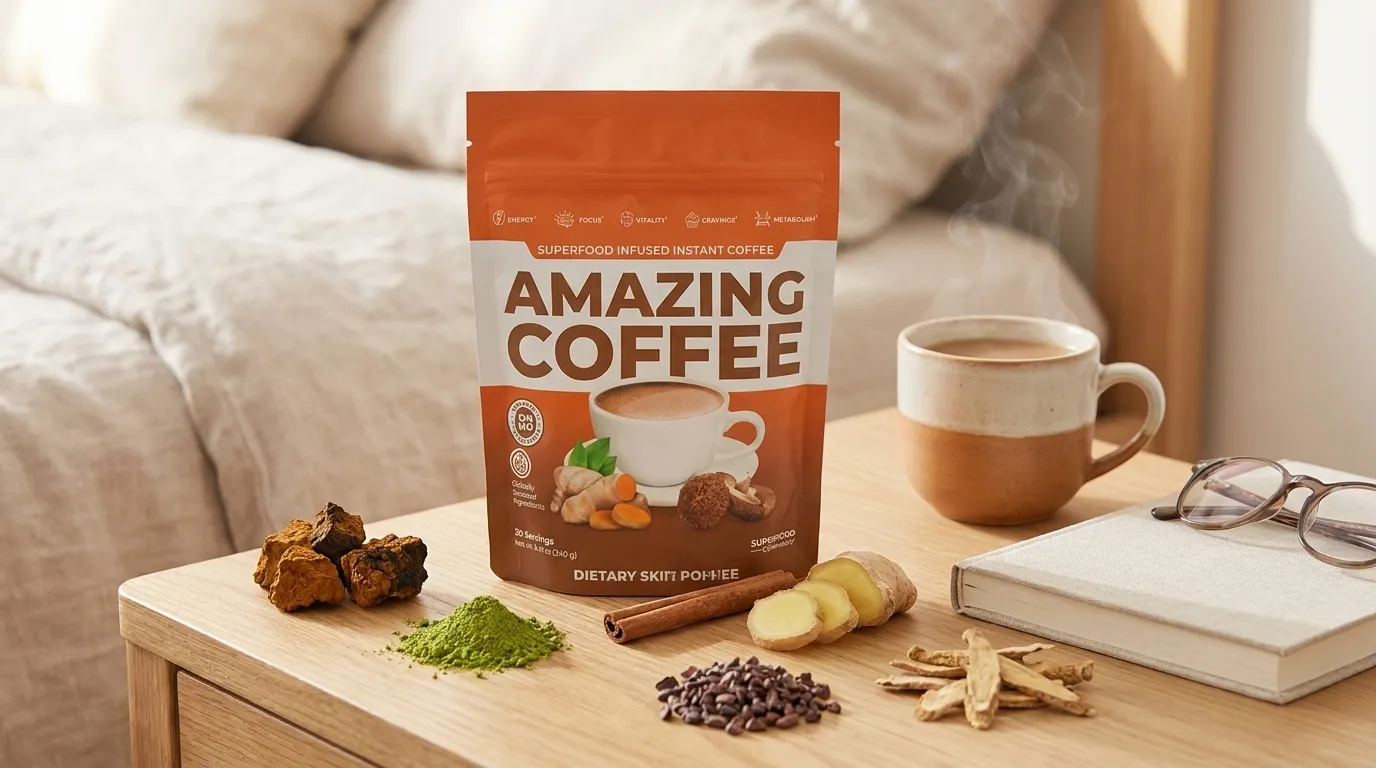
The Second Cup Question: What Amazing Coffee K-Cups Are Actually Doing While You Work


I have a rule I break constantly: no coffee after two. The reason I break it isn't willpower, it's a specific 3 p.m. feeling — the one where my eyes are open but my brain has quietly left the building. For years my only fix was a regular second cup, which fixed the fog and then handed me a jittery, hollow 4:45 in exchange. So when I started drinking Amazing Coffee K-Cups in the afternoon, the thing I noticed first wasn't a benefit on a label. It was the absence of that hollow feeling. The lift showed up, and then it just... stayed put.
People ask me what's actually happening in the cup, and because that's literally my job here — I read the studies so you don't have to — I want to walk you through it honestly. Not "boosts everything!" Just what each ingredient is doing, what the research supports, and where I'd put a caveat.
The caffeine part is real — and that's the point
Let's start with the obvious. This is coffee. There's real French roast and green coffee in here, so there's real caffeine, and I don't want to bury that under mushroom mystique. Caffeine works by a genuinely elegant mechanism: it blocks adenosine receptors in the brain. Adenosine is the molecule that builds up over your waking hours and whispers "you're tired." Block it, and you reduce the perception of fatigue while nudging up alertness, vigilance, reaction time and attention. That's not marketing — that's the consensus in reviews like A review of caffeine's effects on cognitive, physical and occupational performance and the home-testing study Effect of Caffeine on Attention and Alertness Measured in a Home-Setting, Using Web-Based Cognition Tests.
So one customer writing that it "given me extra energy" and another that they "stopped needing naps during the day" — that tracks with a modest, well-timed dose of caffeine doing exactly what caffeine does.
Then why doesn't it crash like a normal cup?
This is the question I get most, and it's where the formula gets interesting. The blend pairs caffeine with things that soften and stretch its edges. Two ingredients matter most here.
Matcha and its L-theanine
There's matcha in the blend, and matcha is a concentrated green tea that's unusually rich in L-theanine — an amino acid that promotes a relaxed-yet-alert state. On its own it's calming. Paired with caffeine, it's the good part: it supports attention while smoothing the stimulant edge, which is the part reviewed in Effects of Tea (Camellia sinensis) or its Bioactive Compounds l-Theanine or l-Theanine plus Caffeine on Cognition, Sleep, and Mood in Healthy Participants. This is, mechanistically, why "focused but not wired" is even possible. A customer put it more plainly than any study: "it doesn't give me the jitters." Another: "does not give me that jittering feeling."
"This is my dessert and my liquid brain during the day." — the phrase a customer used that I think about a lot, because it captures both halves: the treat and the clarity.
Cordyceps and ginseng for the fatigue you feel
Two more ingredients target tiredness from a different angle than caffeine. Cordyceps is a functional mushroom studied for improving oxygen utilization (VO2max) and tolerance to hard effort — see Cordyceps militaris Improves Tolerance to High-Intensity Exercise After Acute and Chronic Supplementation — which can translate to less perceived fatigue. And Panax ginseng is an adaptogen whose ginsenosides have been studied for reducing mental fatigue and supporting working memory, in trials like Antifatigue Effects of Panax ginseng C.A. Meyer: A Randomised, Double-Blind, Placebo-Controlled Trial. Add maca root, a Peruvian adaptogen studied for improving self-reported mood and energy, and you start to understand the reviews describing "more energy for a longer period of time." The caffeine opens the door; these help hold it open.

The weight and appetite angle — the honest version
A lot of the reviews we get mention appetite, and I want to handle this carefully because it's where wellness marketing usually goes off the rails. Here's what's actually in the cup that's relevant.
- Green coffee (unroasted) is rich in chlorogenic acids — polyphenols that may slow glucose absorption and influence fat metabolism, associated with modest body-weight reduction in Chlorogenic acid in green bean coffee on body weight: a systematic review and meta-analysis of randomized controlled trials. Note the word modest. That's the accurate word.
- Green tea catechins (notably EGCG), especially alongside caffeine, modestly raise energy expenditure and fat oxidation — reviewed in Effect of green tea catechins with or without caffeine on anthropometric measures and the EGCG energy-expenditure meta-analysis.
- Cinnamon polyphenols may improve insulin sensitivity and slow gastric emptying, supporting steadier post-meal blood glucose (The effect of cinnamon supplementation on glycemic control in patients with type 2 diabetes mellitus). Steadier blood sugar is often what stands between you and a 3:30 cookie.
None of these is a weight-loss drug, and I'd never sell it as one. But steadier energy plus a genuinely satisfying, dessert-like flavor is a real reason people reach for snacks less. That's the mechanism behind reviews like "Most importantly, it suppresses my hunger," "curbed my appetite," and my favorite for its bluntness, "my muffin top is shrinking daily." I'd read those as: it slots into the treat-shaped hole in your afternoon without the sugar spike.
The quiet supporting cast
A few ingredients aren't about the lift at all — they're the reason the cup feels good rather than harsh, and they're why some people find it "gentle on the stomach versus regular coffee."
- Turmeric — its active polyphenol curcumin down-regulates inflammatory signaling (NF-kB), lowering markers like CRP, IL-6 and TNF-alpha (Profiling Inflammatory Biomarkers following Curcumin Supplementation: An Umbrella Meta-Analysis).
- Ginger root — its gingerols and shogaols have antioxidant and anti-inflammatory activity and can lower circulating inflammatory markers.
- Cocoa flavanols — these improve blood-vessel function and cerebral blood flow, which is linked to better mood and reduced mental fatigue (the CoCoA study and related trials). This is also, not coincidentally, where the mocha-chocolate taste comes from. One reviewer said they "did feel some brain fog lift" — cocoa flavanols are a plausible part of that story.
- Shiitake beta-glucans (including lentinan) prime immune cells; daily intake improved immune markers and lowered CRP in Consuming Lentinula edodes (Shiitake) Mushrooms Daily Improves Human Immunity.
- Chaga — rich in polyphenols and D-glucans with antioxidant and immunomodulatory activity, though I'll be straight: that evidence is mostly lab and animal so far, per A brief overview of the medicinal and nutraceutical importance of Inonotus obliquus.
So what does "benefits" actually mean here?
If I'm being a dietitian and not a hype machine: the strongest, best-supported benefits are the steady, jitter-lighter alertness (caffeine + L-theanine), the fatigue relief that outlasts a normal cup (cordyceps, ginseng, maca), and the appetite and blood-sugar steadiness that comes from green coffee, green tea, cinnamon and a flavor satisfying enough to stand in for dessert. The mushrooms and spices are the supporting cast — real ingredients with real research, playing a longer, quieter game.
My practical take: drink it as your afternoon cup, the one that used to betray you. Give it about ten minutes to come on. Notice whether 4:45 feels different. In my kitchen, it does — and I've read enough studies to know why.
These statements have not been evaluated by the Food and Drug Administration. This product is not intended to diagnose, treat, cure, or prevent any disease. The research cited above describes individual ingredients studied in isolation, not the finished Amazing Coffee K-Cup product, and results in those studies may not reflect any individual's experience. Statements from customer reviews are personal opinions and are not typical or guaranteed results. If you are pregnant, nursing, taking medication, or managing a health condition, talk with your healthcare provider before adding a caffeinated functional product to your routine.
Priya is a registered dietitian who reviews the science behind every ingredient we use. She spends her days turning clinical research into plain English.
Ready to try it for yourself?
Shop Superfoods Company