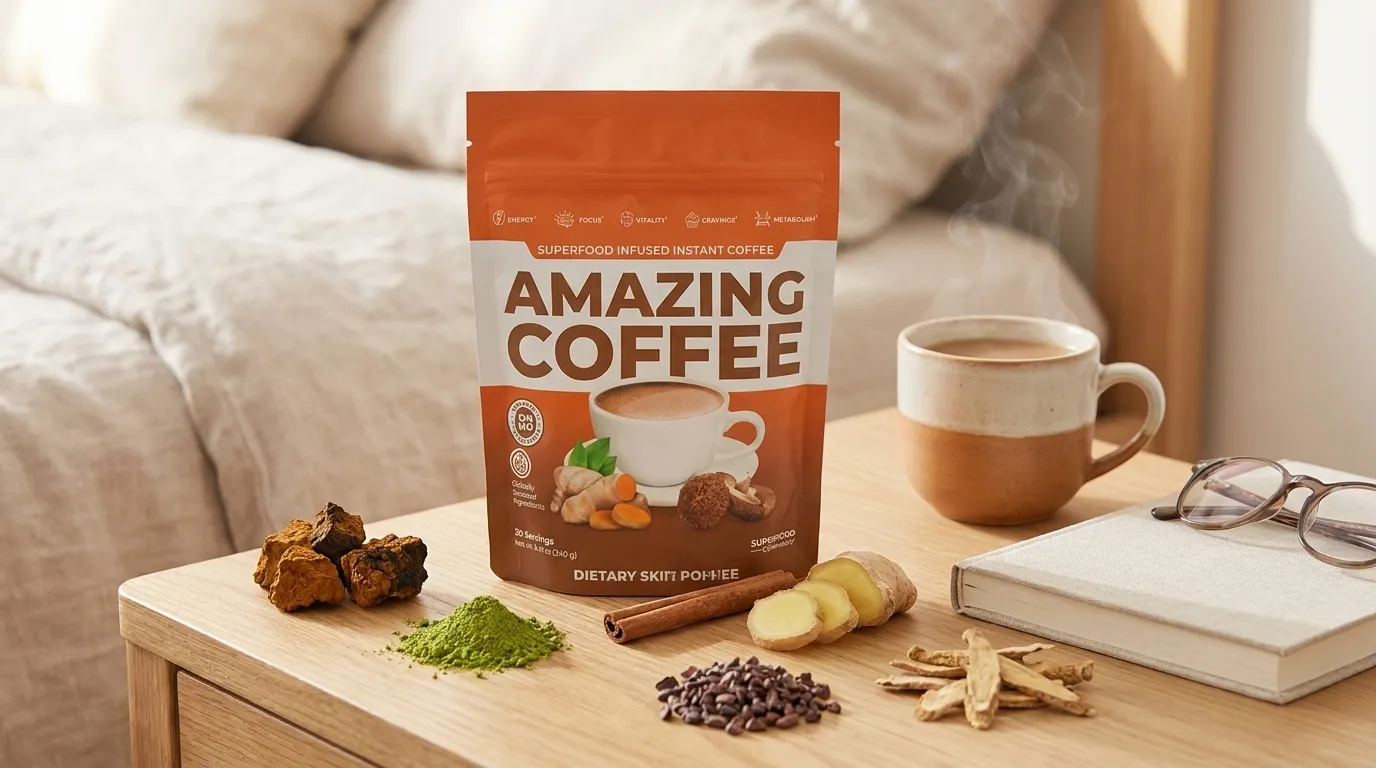
Why People Keep Adding Mushrooms to Their Coffee

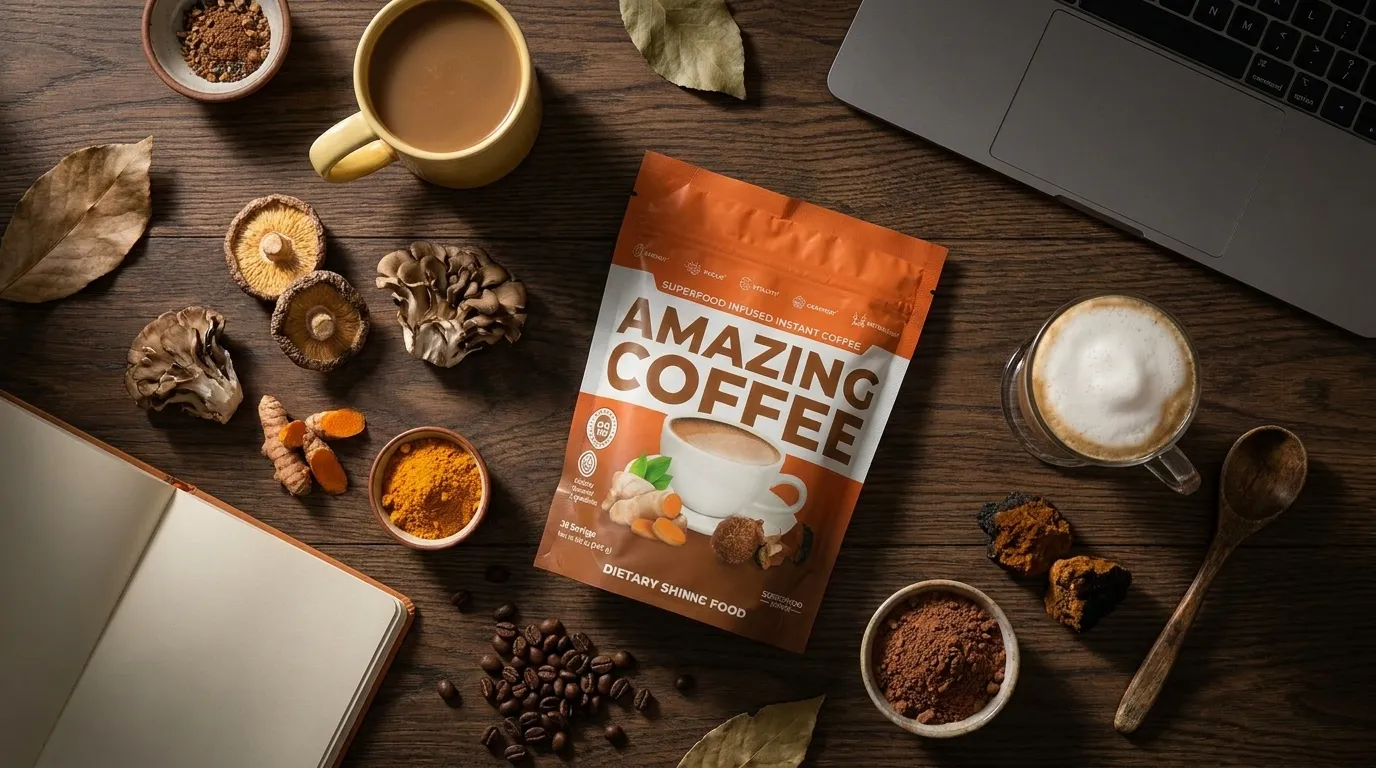
The first time someone told me to put mushrooms in my coffee, I laughed. I had a picture in my head — gritty, woodsy, the kind of thing you choke down because it's supposedly good for you. That picture was wrong, and it took exactly one morning to find out.
Mushroom coffee has quietly gone from health-store curiosity to one of the fastest-moving corners of the coffee aisle. The adaptogen market has been growing more than 8% a year, driven by people who love their morning cup but have started to wonder if it has to come with a 2 p.m. crash. So let's talk about what's actually going on in there — minus the hype.
What's actually in the cup
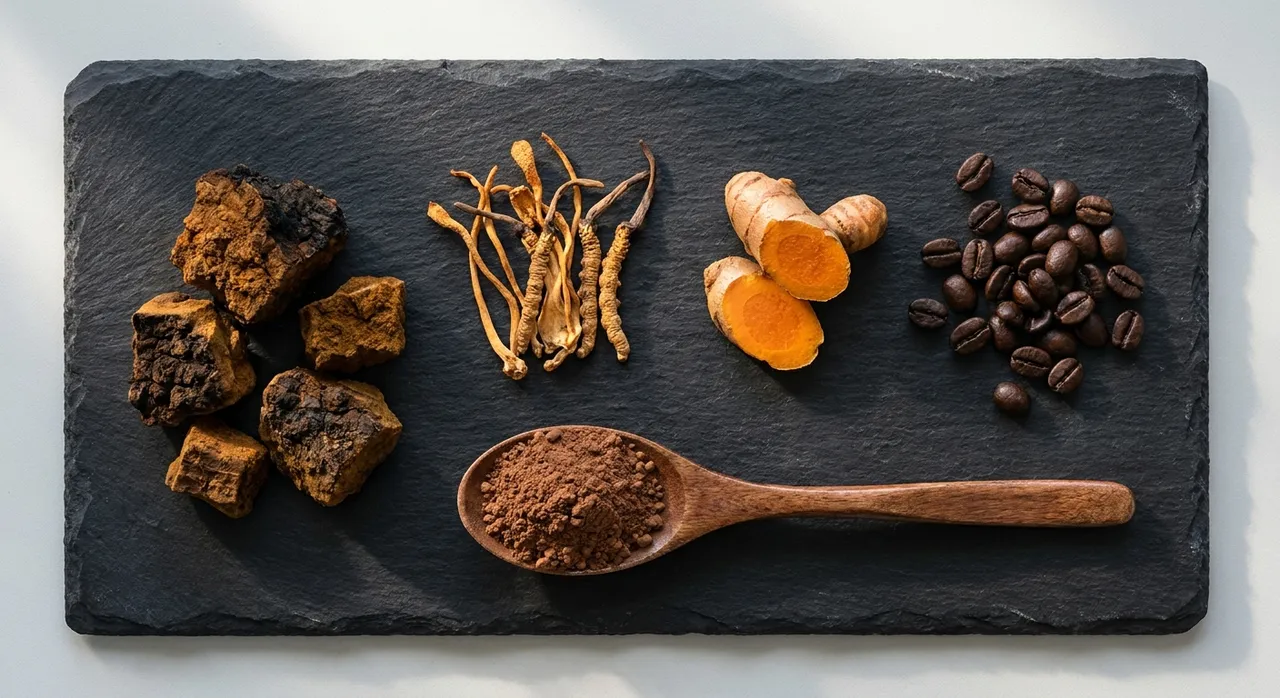
"Mushroom coffee" is a slightly misleading name. The good blends are really coffee plus a small pharmacy of plants. Our own Amazing Coffee is built on real French-roast instant coffee, then layered with thirteen superfoods: chaga, cordyceps, shiitake, turmeric, maca root, ginseng, matcha, green tea, green coffee, cinnamon, ginger, cocoa, and a normal hit of caffeine — about 165 mg, the same as a regular strong cup.
That last number matters, because it clears up the biggest myth right away. A lot of people assume "no jitters" means "barely any caffeine." Not here. The smoother ride comes from what's riding alongside the caffeine.
The jitter question, honestly
Here's the part I find genuinely interesting. Green tea and matcha both contain L-theanine, an amino acid that's been studied alongside caffeine for years. A 2012 study in Nutritional Neuroscience found that L-theanine blunted the blood-pressure bump caffeine causes and reduced how jittery people felt — without dulling the alertness. It nudges up calming brain chemistry (GABA, serotonin) and encourages alpha brain waves, the relaxed-but-focused state.
Pair that with caffeine and you get the thing people keep describing in our reviews, almost word for word:
"Gives me energy without the jitters." "Energy without the caffeine jitters." "Doesn't bother my stomach at all."
I'm not going to pretend a cup of coffee rewires your nervous system. But the slower onset and softer landing are real, and they're the single most common reason people tell us they switched and stayed.
Chaga and cordyceps: what the research actually says
This is where it's worth being careful, because the internet is not. So here's the measured version, pulled from the human and clinical studies — not the headlines.
Cordyceps is the endurance one. In a double-blind, placebo-controlled trial (Cordyceps sinensis improves exercise performance in healthy older subjects), supplementation improved exercise tolerance, likely by helping cells use oxygen and produce ATP more efficiently. It's traditionally been a stamina herb for centuries; the lab work is finally catching up.
Chaga is the antioxidant one. It's unusually rich in compounds like melanin and superoxide dismutase, and studies on Inonotus obliquus (chaga's botanical name) have measured strong free-radical-scavenging activity. Antioxidants are the body's cleanup crew, and chaga brings a big one.
And turmeric earns its spot for more than color. Curcumin, its active compound, crosses into the brain and has been studied for memory — an 18-month placebo-controlled trial found a bioavailable form improved memory and attention in non-demented adults. It also calms the same inflammatory pathways (NF-κB, COX-2) that over-the-counter anti-inflammatories target.

How people actually drink it
The honest truth: the people who stick with mushroom coffee are the ones who didn't have to change their routine. So that's how I'd start.
- The straight swap. One scoop, 8 oz of hot water, stir. If you take your coffee black, you'll be surprised — the cocoa and cinnamon round it out so it doesn't taste like "supplement."
- The morning latte. Scoop into a mug, add a splash of hot water to dissolve, then top with steamed or frothed milk (oat milk is lovely here). This is my daily.
- The afternoon iced version. Dissolve a scoop in a little warm water, pour over ice, add cold milk. Because it's gentler, a second cup at 3 p.m. doesn't wreck your night — several customers mention drinking it after dinner and still sleeping fine.
So — is it worth switching?
If your coffee already treats you well, there's no rule that says you have to change anything. But if you've been quietly negotiating with your afternoon crash, or your stomach, or that wired-but-tired feeling, mushroom coffee is one of the lowest-effort experiments in wellness. You're not adding a new habit. You're upgrading one you already have.
That's the whole pitch, really. Same ritual, same warm mug in your hands — just a lot more going on inside it. If you want to see exactly what's in ours, the full ingredient breakdown lives on the Amazing Coffee page.
These statements have not been evaluated by the Food and Drug Administration. This product is not intended to diagnose, treat, cure, or prevent any disease. Studies referenced describe individual ingredients, not this finished product.
Marcus writes about the small daily habits that actually add up. A reformed energy-drink addict, he's spent the last decade chasing a better morning.
Ready to try it for yourself?
Shop Superfoods Company